Clarios has launched IdleLess, a battery monitoring technology that slashes engine idling time by up to 60%, helping carriers save thousands of dollars in fuel costs per truck annually.
“Clarios Connected Services’ solution offers real-time alerts to drivers and fleet managers to switch off the vehicle, saving up to $3,300 [all figures USD] in fuel costs per truck per year,” Junior Barrett, global director of business development told journalists in Anaheim, Calif.
The technology also eradicates 8.6 metric tonnes of CO2 emissions per truck yearly, he added, as the product was launched in Canada and the U.S.

“The solution not only maximizes battery potential but also revolutionizes the way drivers and fleet managers understand and utilize battery power,” Cagatay Topcu, vice-president of connected services said.
He added that with real-time battery monitoring, advanced algorithms, and instant communication, drivers can embrace idling reduction, knowing they have reliable insights. This approach ensures that batteries are used to their fullest potential, reducing unnecessary idling and boosting overall efficiency.
Sensor and gateway
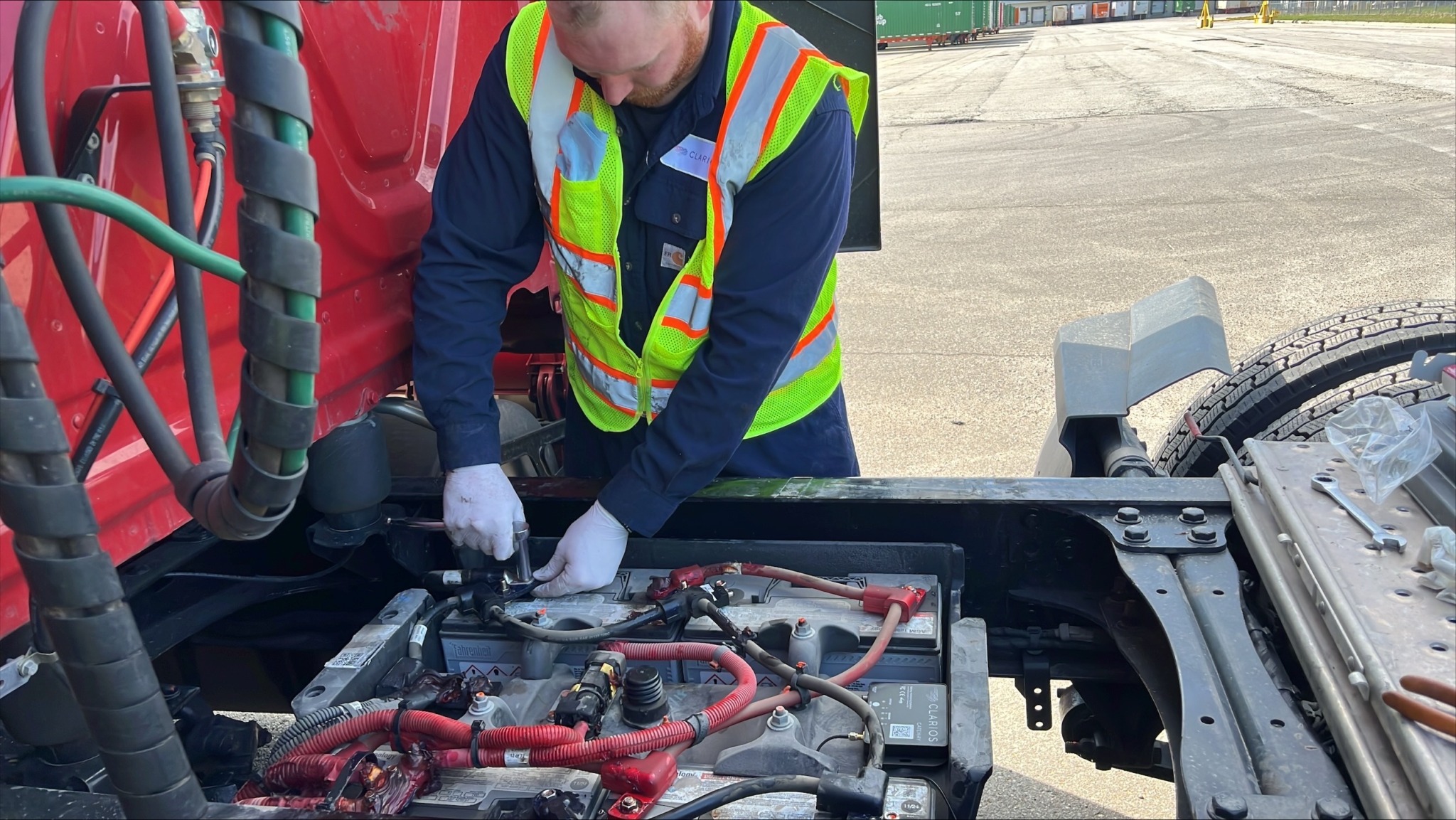
Christina Yarnold, director, product management, connected services explained how the system that consists of a sensor and a gateway – an IoT device – works. The sensor is screwed on under the battery and connected to the gateway that collects the raw data and sends it to the cloud. Here, Clarios’ proprietary algorithms crunch the data and provide real-time alerts that are communicated to the user.
There is a one-time $500 fee for the hardware and installation, she added. The user signs up for a monthly subscription with a baseline of $43, Barrett said.

IdleLess relies on three components to achieve savings – battery data, algorithms and communications.
The sensor collects voltage, current and temperature data for various events with the appropriate frequency, which is sent to the Clarios cloud via a cellular gateway for processing.
AI algorithms
Advanced AI algorithms convert raw data into predictive insights on battery state of charge. These are converted into actionable alerts, notifying drivers and fleet managers when to start and stop their engines to maximize fuel savings while minimizing the risk of a battery related downtime event.
This also reduces wear and tear on the vehicle, Yarnold said, because the engine and other components or the vehicle are not running. Fleets can avoid unnecessary maintenance and use resources more efficiently, leading to further cost savings. Over a five-year period, fleet operators can save more than $13,000 per vehicle by implementing the solution, the company claimed.
Topcu said that keeping cybersecurity in mind, the data is encrypted and independent auditors check on its security. He added that the hardware has a five-year life cycle. In the future, Clarios plans to use weather data in the future to make the solution more efficient and accurate.
The technology was tested in Europe, and a European commercial fleet operator has signed a contract. Six pilot projects are underway in the U.S., Barrett noted.