The North American Council for Freight Efficiency (NACFE) has released initial findings from its Run on Less – Messy Middle demonstration.
“While we will be doing a deeper dive into the data in the coming weeks and months, we are excited to share our initial findings from this unique event which featured 13 fleets and four different powertrain options,” said Mike Roeth, NACFE’s executive director.

The latest demonstration examined a range of powertrains, and each proved to have its benefits. Natural gas trucks satisfied the needs of diesel with more power, torque, range, and quick fueling times, NACFE found.
Battery-electric trucks’ range, weight and costs are becoming more competitive with diesels. But while production of renewable fuels is on the rise, NACFE said it remains well below what’s needed for widespread adoption. Hydrogen fuel-cell-electric trucks are showing promise in certain use cases, NACFE found.
The Run on Less program also found fleets continue to value sustainability despite shifting regulatory requirements, but they are seeking a good return on their investments.
“The Run on Less showcase provides an excellent opportunity for fleets to see firsthand how technology innovations are delivering results across diverse duty cycles,” said José Sampiero, vice-president, on-highway engine business, Cummins. “This real-world collected dataset will continue to reinforce what some customers are already experiencing.”

Some achievements stood out during the demo. Two diesel trucks traveled a combined 22,500 miles (36,000 km) with an overall fuel economy average of 11.6 mpg. A truck fueled by biodiesel, meanwhile, ran 5,418 miles (8,668 km) averaging 9.5 mpg.
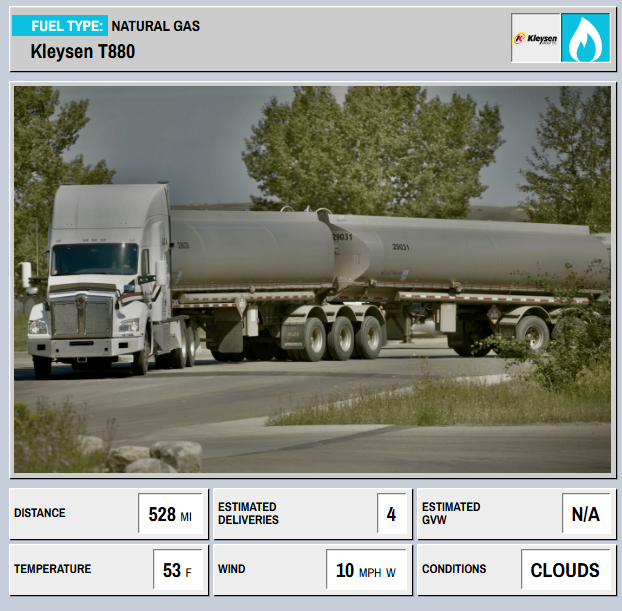
Three natural gas trucks handled challenging routes and heavy payloads – including triple trailers in some instances – with the majority of those 20,739 miles (33,182 km) running gross vehicle weights in excess of 120,000 lb.
A highlight among battery-electric vehicles was one that ran 465 miles (744 km) on a single charge. Another battery-electric truck covered 875 miles (1,400 km) in a single day and 5,740 miles (1,984 km) over 18 days, relying only on public charging.
And a hydrogen-fueled truck achieved 100% uptime and covered 4,076 miles (6,522 km) consuming 7.8 miles (12.48 km) per kg of hydrogen.
“We will release a dataset that will include detailed metrics from all 14 trucks on Nov. 3; we will publish a report in January on the mechanics of the Run; we will hold a ‘potluck’ data analysis workshop in February; and we will publish a detailed analysis of the findings from the Run by mid-2026,” Roeth said.
He elaborated on this year’s Run during a virtual press conference on Oct. 23, saying, “This is the most comprehensive one we’ve done.”

The idea was “to bring clarity to longhaul decarbonization” and that included assessing clean diesel. NACFE continues to believe battery-electric and fuel-cell vehicles fueled by clean energy will be the long-term winners, “but there’s a middle here.”
And Roeth also insisted interest in decarbonization remains high, as evidenced by the 797 registrants who participated in one of the Run’s 12 sessions and three workshops. This year, 14 trucks at 13 sites participated in the event, including Kleysen Transport in Alberta, which proved the new 15L natural gas Cummins engine can handle heavy payloads.
“We wanted to see if the natural gas trucks could really do the job of some of the harder diesel operations,” Roeth said. “We concluded — yes they can.”
While NACFE has released initial findings, it’s only beginning to analyze the data it collected. “We’ve done 1/100th of the analysis we’re going to do with this Run on Less data,” Roeth promised.