Samsara is rolling out a new feature to alert drivers on hazardous weather conditions, a contributor to about 20% of crashes.
Speaking to the press at the American Trucking Associations Management Conference & Exhibition, Johan Land, senior vice-president and head of safety and AI with Samsara, noted that truck crashes are rapidly increasing.
Land said there’s been a 49% increase in the number of trucks involved in fatal crashes over the past 10 years and he said AI cameras can help counter that trend.

While weather forecasting has been available through the Samsara platform for quite some time, the company is leveraging AI to make it more effective. Customers will now be able to see through Samsara’s AI camera the exact conditions their drivers see through their windshields.
Those fleets that don’t have trucks within a current weather system can tap into the broader population of Samsara-equipped vehicles to see those conditions. Customers can opt out of the feature, but in order to access those snapshots from other companies’ vehicles, they’ll have to agree to share the view from their own cameras.
Land said the new feature means it’s no longer necessary to use separate apps to monitor weather conditions. Customizable audible alerts can be sent to the drivers to warn them of incoming poor conditions or suggested reroutings.
In the future, AI will be able to automatically reroute trucks based on weather conditions.
Land also said AI is improving how effectively fleets can monitor driver behavior, not just to coach drivers with frequent bad behaviors, but also to reward those who’ve done well to avoid a potential crash. For instance, a harsh braking incident was traditionally viewed as a bad behavior, but in some cases it was needed to prevent a crash. AI can help differentiate between the two actions.
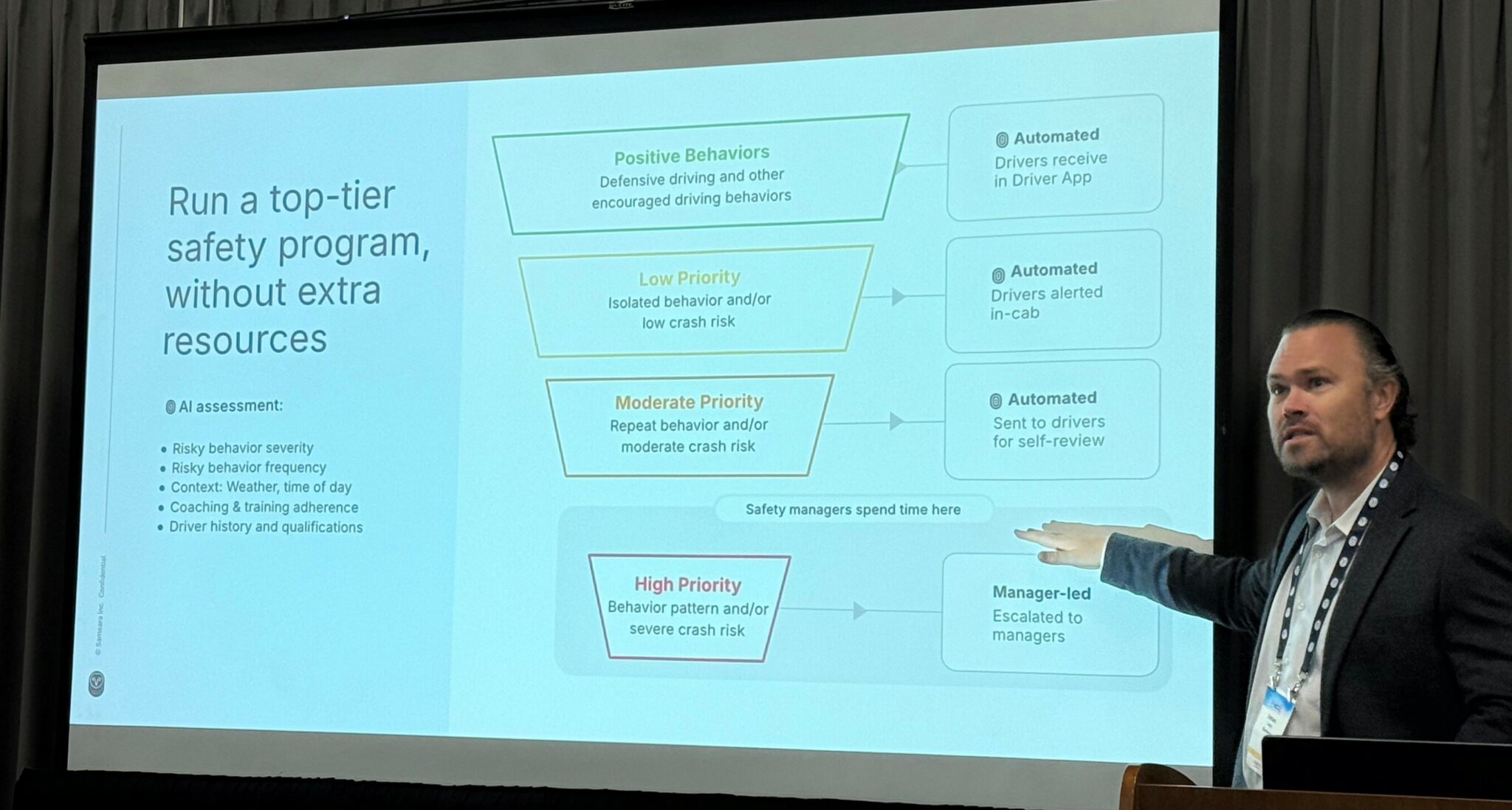
AI cameras, Land said, allow fleets of all sizes to “run a top-tier safety system without extra resources.” The AI classifies drivers into several categories, ranging from low priority for those who self-correct to in-cab alerts, up to high priority drivers who ignore such warnings and need manager intervention. “One carrier has a single person managing and coaching 1,000 drivers because of this,” he said. “They’re using AI coaching for the vast majority of it and some, they need to sit down and spend time with [the drivers]. That is the future of this type of AI training.”