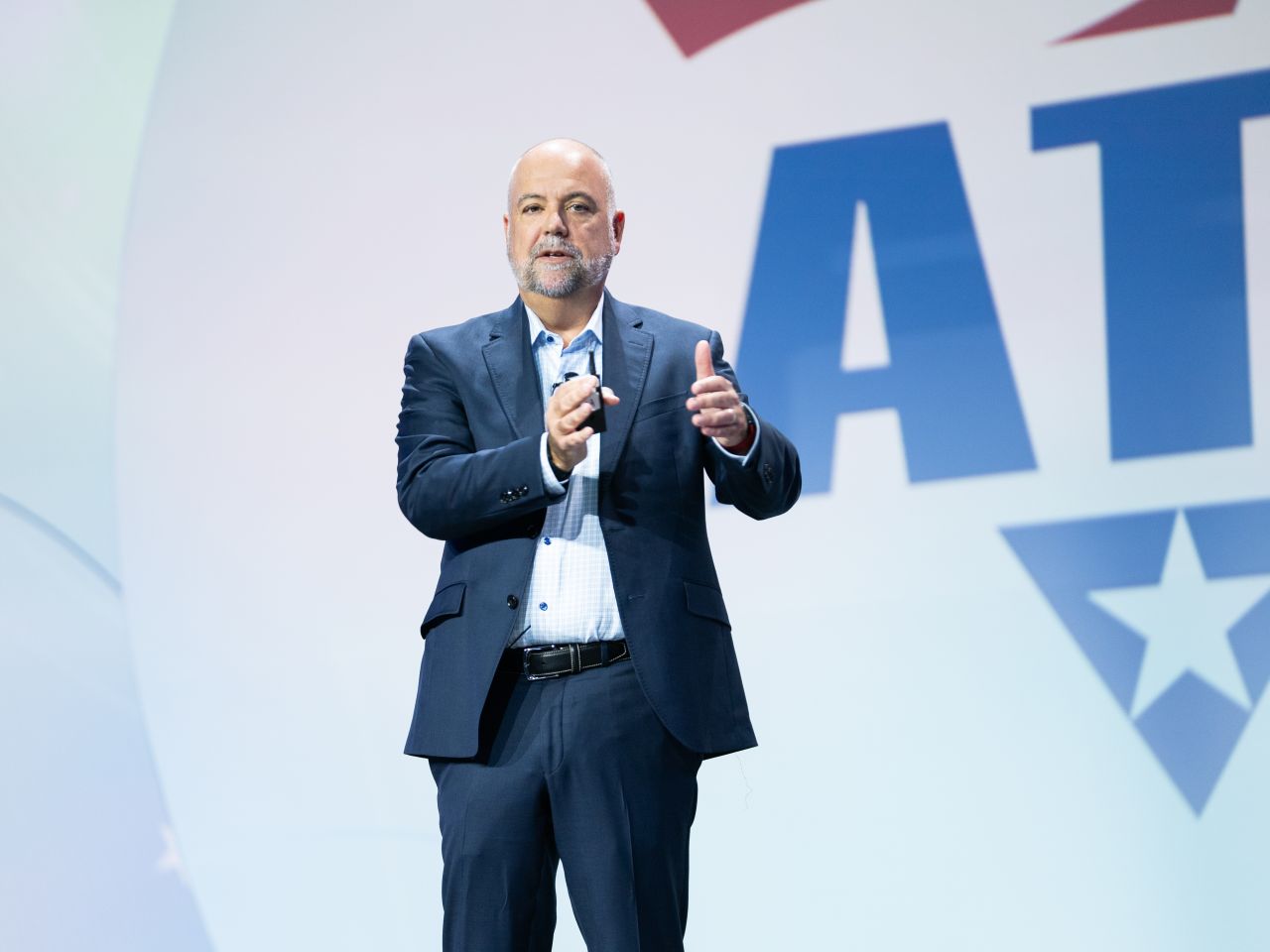
Trucking finds itself in unprecedented times, according to Bob Costello, chief economist of the American Trucking Associations (ATA).
Optimism about an economic lift at the beginning of 2025 has given way to the reality that the longest freight slump in memory has extended into a third year. Costello does not foresee an economic recession on the horizon, but any uptick fleets experience in the coming quarters will likely be from an accelerated reduction in industrywide capacity.

“Any recovery in trucking is not going to come from the demand side,” Costello said during a presentation at ATA’s Management Conference & Exhibition in San Diego. “If freight levels do not improve much and costs remain high, we will see an acceleration of failures.”
Even with some economic data unavailable due to the ongoing U.S. government shutdown, it is clear that consumers are concerned, which could result in lower spending. The pace of inflation has slowed, but prices for goods remain elevated, and households are cautious about buying new vehicles, homes, and large goods.
Labor market has weakened
Over the course of 2025, “the labor market has weakened, and weakened significantly,” said Costello. The absence of major layoff announcements had kept job figures from turning negative, but employers are more reluctant to hire.
However, the manufacturing sector, so critical to trucking’s health, has contracted for seven consecutive months, according to the Institute for Supply Management. That includes an estimated 42,000 factory jobs lost over the past four months.
Price pressure from tariffs to accelerate
Thus far, U.S. consumers have felt only a minimal impact from tariffs, but Costello expects that to change. Estimates are that half of imports entering the United States are semi-finished products used in the manufacturing process, and could be subject to a tariff.
Using baseball as an analogy, Costello said, “we are only in the bottom of the second or third inning” on the potential impact of tariffs for trucking and the larger economy.
Shedding truck supply a ‘necessary evil’
“It is taking a long time, but I am more convinced than ever that supply is coming out,” Costello said of trucking’s capacity glut.
That applies in particular to truckload fleets, whose costs are rising while freight demand and rates remain depressed. It also applies to the less-than-truckload sector, with key metrics like average weight per shipment continuing to underperform. This has left more fleets on the brink of failure, said Costello.
On an earnings call with analysts earlier in October, Adam Miller, CEO of Knight-Swift Transportation Holdings, outlined the profile of fleets unlikely to survive much longer: “medium-sized carriers who invest in safety and compliance, but do not have the scale to overcome cost inflation in the unsustainably soft price environment our industry has faced over the last three years.”
The Trump administration’s focus on the English-language proficiency of truckers and the issuing of non-domiciled commercial driver’s licenses are slowly removing capacity. An expected crackdown on illegal cabotage should benefit U.S. trucking fleets as well, said Costello.
On the Knight-Swift earnings call, Miller cited larger fleets pulling back from over-the-road service to dedicated opportunities and the plateauing growth of private fleets as additional factors that should further remove capacity.