While many of us stared at our computer screens watching, bemused, as Elon Musk unveiled his Tesla Semi, Trevor Plett’s wheels were already turning. That was Nov. 16, 2017. Just six months after Musk rolled in from stage left and bailed out of the truck to a cheering crowd, Plett placed an initial deposit for 10 of the Tesla Semi wonder trucks.
“Our interest in electrifying our trucking fleet began when Elon Musk announced the Tesla Semi,” said Trevor Plett, operations manager at Langley, B.C.’s RR Plett Trucking. “We’re still waiting for those units to be delivered, but at the time it felt like the future of electric transport was within reach.”

Fast forward to the summer of 2023; Plett learned grants were coming available through Plug-In BC for electric charger installations.
Since its site already had unused electrical capacity, it was able to install a charger without needing a BC Hydro service upgrade.
The grant was approved the following spring, and shortly thereafter RR Plett commissioned the first of two 120-kW DC fast chargers.
A month later Plett got a call from George Pyne of Volvo Pacific Coast Heavy Truck Group, advising them he had a VNR Electric available for testing.
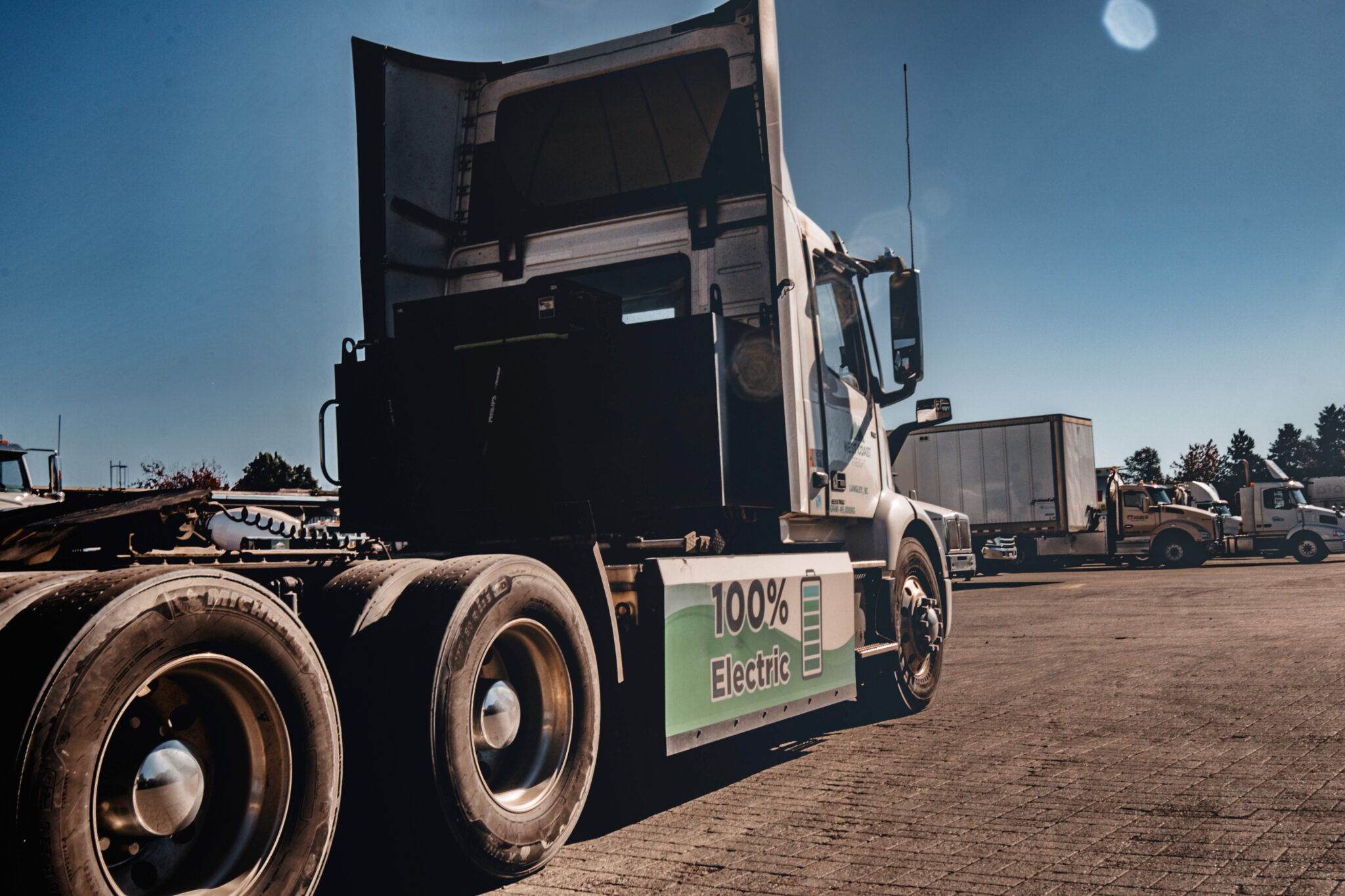
“It was the first OEM truck we’d seen that truly met our range and power requirements,” Plett told trucknews.com. “We purchased our first VNR Electric in June 2024, and after seeing how well it performed in our operations, we added a second one in July 2024.”
RR Platt now has six of them. Four more took their place in RR Plett’s local fleet, called West Coast Freight, this past February.
Operational fit
West Coast Freight, an asset-based fleet in business since 1978, offers local drayage services across the Greater Vancouver area as well as local and long-distance drayage from Vancouver ports: Deltaport, Vanterm, Centerm, and Fraser Surrey Docks.
The VNR Electrics run about 300 kilometers (188 miles) per day over 10-hour shifts. There were concerns at first about range, but some minor adjustments to the routes, and keeping the trucks on dedicated runs within a comfortable margin, has alleviated those initial concerns.
The dispatch team does use the BEV fleet more strategically than the diesel fleet, keeping the routes shorter. Plett said it was a learning process at first to get dispatch to pay closer attention to those six trucks.
This is even more important in the winter months when range is further restricted. Vancouver doesn’t get terribly cold in the winter, but when the temp does dip below freezing, dispatch has a bit more to think about.
“We see a reduction in range of about 10-15%,” Plett admits. “Dispatch has to further strategize during their planning for each day to ensure trucks are routed more efficiently.”
“There was a bit of a learning curve for the drivers to understand how to use regenerative braking, but we’re past that now,” he added. “And we hardly ever have to remind them to plug the trucks in when they come back to the yard on a break. Opportunity charging is still really important.”
Plett says the drivers really enjoy using them. They claim they are less tired at the end of the shift because there’s so little noise in the cab — and there’s no diesel fuel smell on their clothes, or exhaust fumes.
“I would say overall, operationally, they have met or even exceeded our expectations,” he said.
Charging infrastructure
The company owns its on-site charging facilities; two Terra 124 120-kW DC fast chargers from ABB. Each charger costs about $100,000 before grants, Plett said.
The company dodged one of the more costly hurdles to electrification in that the terminal in Port Kells, near Langley, was formerly a heavy industrial site. It already had high voltage lines on site.
“We were fortunate that our facility had underutilized heavy power on site,” he said. “We only had to work with an electrical contractor and city permitting offices to get our chargers up and running.”
Plett is optimistic that the additional charging capacity can be installed by the end of 2026.
“BC Hydro has been very cooperative,” Plett said. “They have been pushing hard for us to advance our fleet electrification goals.”
The two chargers serve the six-truck fleet adequately, but they will need more capacity to power additional trucks over the next few years. Plett is already working with an electrical engineering firm and BC Hydro to develop the anticipated 1.5-megawatt charging infrastructure.

The business case
Plett is 16 months into the first two trucks, and eight months along with the other four, but at this point he says the business case is coming together. It’s not certain yet, but the indicators all point in the right direction.
“We do not know yet what the residual value of the trucks will be after six or seven years when we’ll be looking to buy new equipment,” he points out. “We also can’t predict the reliability of the trucks or any range degradation we might see as we get into years four to six.”
But, so far, the financials do seem to be working.
What is rapidly becoming obvious are the fuel savings and the reduction in maintenance and repairs.
“The initial cost is about $80,000 more for an electric truck compared to a diesel. So. we’re seeing with the cost savings on fuel and repairs, our break-even — to where it would be comparative to a diesel — is about the three-year mark,” Plett said.
Without the subsidy and government support Plett said it would not have made the decision to jump into BEVs at this time. Both the federal and provincial grant programs helped reduce the cost delta between a standard Class 8 diesel truck and the BEV option.
“I believe the programs available are sufficient to make it possible for fleets to begin the transition to BEV,” he emphasized.
“And it’s not just the trucks, you have to look at your charging infrastructure as well when looking at your break-even point. It’s all part of the total investment in electrification.”
And the charging costs, including the infrastructure they own, are included in the three- to four-year break-even predictions.

Intangible benefits
Plett reports his customers are proud to be early adopters of this emerging green technology from an optical perspective. But there are tangible benefits too, when it comes to Scope 3 emissions calculations, for example.
Scope 3 emissions are the indirect greenhouse gas emissions occurring in a company’s value chain, including both upstream and downstream activities, such as those from suppliers and product use.
“They see their operation as contributing to cleaner air, reduced emissions, and a more forward-looking supply chain,” Plett suggests. “There’s good public relations value in being able to say your freight arrives via zero-emissions vehicles. It resonates with their corporate responsibility or ESG goals.”
The Port of Vancouver is onboard with the idea of zero-emission electric trucks for many of the reasons just mentioned. BC Hydro is encouraging RR Plett Trucking to move ahead with its expansion plans, and it’s even getting some attention from local media and environmental groups.
As previously noted, the company is already planning a phase 2 charging infrastructure project. As with any fleet getting into BEV you first need to plan out your charging infrastructure before adding the actual vehicles. “As long as the grants are in place we are ready to move forward with an additional 24 BEV over the next three years,” Plett said.
Those 24 additional trucks probably won’t be Teslas.
Production of the Tesla Semi was originally slated to begin in 2019. That date was pushed out first to 2022, then to 2024, and more recently to 2025. Now, according to reports in Electrek from Tesla watcher, Fred Lambert, Tesla is planning serial production sometime in Q2 2026, with full production slated for some time late next year.
And Lambert, citing knowledgeable sources, says there appears to be a serious price hike in the works.