Peter MacLeod hears how Locus Robotics leverages AI and data to optimise warehouse operations, boost efficiency, and deliver measurable ROI.
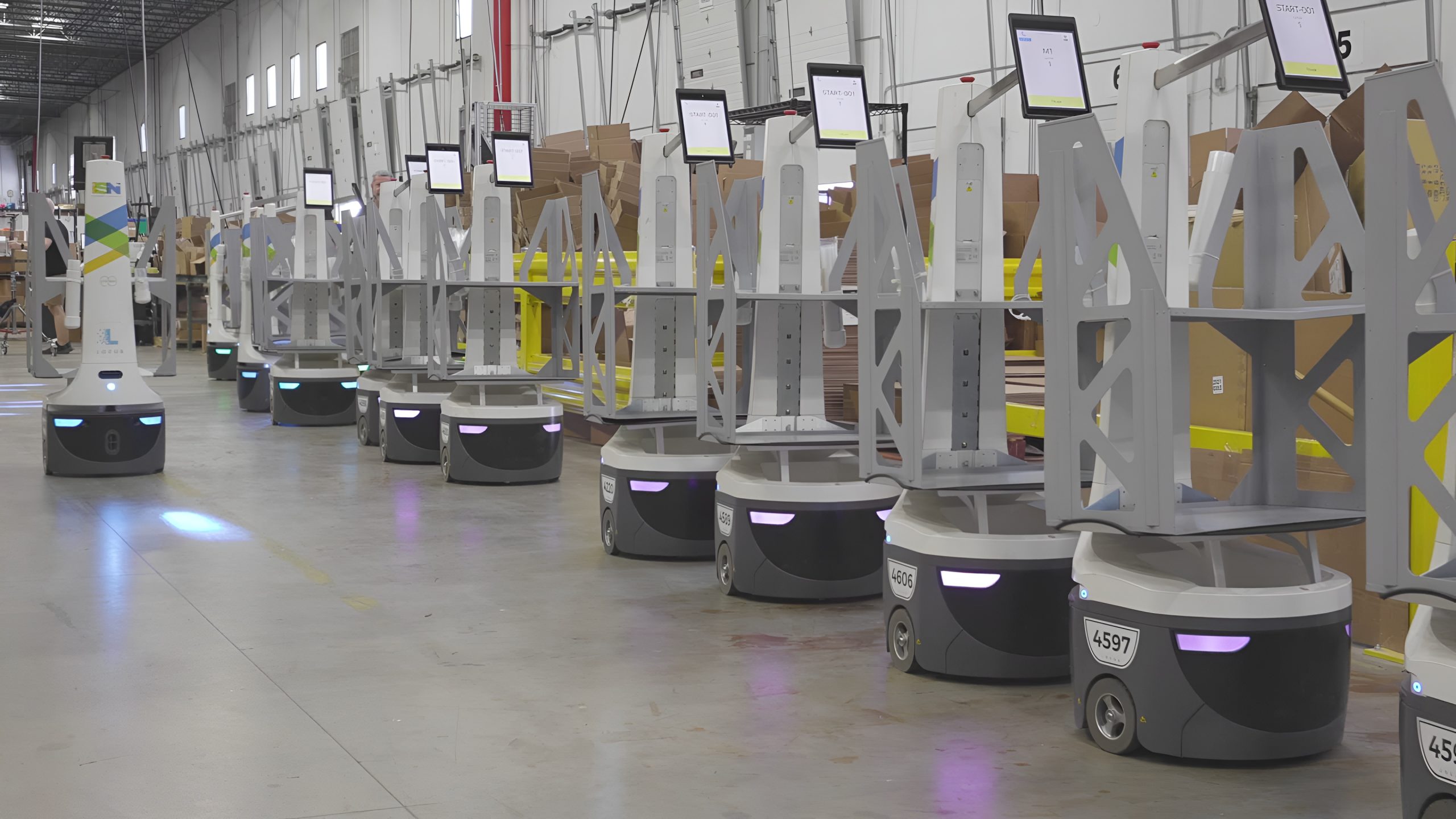
AI is becoming increasingly embedded in warehouse operations, driving efficiency and delivering measurable return on investment (ROI). It is therefore unsurprising to learn that Locus Robotics, a company renowned for its global deployment of autonomous mobile robots (AMRs), is at the forefront of this transformation, leveraging AI to optimise warehouse workflows and enhance operational performance.
Dr. Oscar Mendez Maldonado, director of AI and data science at Locus Robotics, brings a unique perspective to the table. Having spent a decade in academia running a robotics and AI research lab, Mendez transitioned to the commercial sector two years ago, drawn no doubt by the sheer volume of operational data Locus collects. “Data is the thing that you want. Ninety per cent of AI is just data science – manipulating data, getting data, understanding it, and then building AI on that,” he explains. His academic background informs the company’s sophisticated approach to AI, blending research-grade expertise to create and develop practical warehouse applications.
Within logistics, Mendez is quick to highlight the nuances within the AI sphere: “AI means different things to different people. It’s a bit of a moving goal post, or a marketing term,” he observes. The current buzz around language models and generative AI mirrors earlier waves of excitement in computer vision, he says, with companies initially adopting AI as a black-box replacement for existing processes. “You will get to a point where you have to crack open that black box and inject some domain expertise,” he warns, emphasising that understanding operational workflows is key to extracting genuine ROI.
Performance Gains
At Locus, AI is designed to deliver tangible benefits across the warehouse floor to its customers. One example is System Directed Labour, a software-driven approach that guides associates’ picking routes in real time. “From the user’s point of view, it’s a very small change. All they get is a screen that says, ‘Go to aisle eight,’ or ‘Go to aisle seven,’” Mendez explains. Behind the scenes, a sophisticated AI engine optimises routes based on the location of all robots and personnel, yielding performance increases of five to 10 per cent on deployed sites. Beyond productivity gains, the system also reduces training time for new associates, supporting flexible labour models and accelerating onboarding.

Core Principles
AI’s impact extends beyond picking efficiency. Locus employs AI for obstacle detection, enhancing robot navigation in complex warehouse environments, and for improving responsiveness in customer service by parsing large datasets to enable quicker decision-making. “It ranges from really hard, lines-per-hour increases, all the way to soft benefits, improved robot navigation and improved response times,” says Mendez.
Mendez describes three core principles underpinning Locus’s AI development: physical, trustworthy, and holistic. Physical AI must manifest tangible improvements in operations, directly affecting robot behaviour and interactions within the warehouse. Trustworthy AI ensures explainability and accountability; every component can be tested and understood, avoiding opaque black-box solutions. Holistic AI considers the warehouse as a whole, optimising performance for the site rather than individual pickers. “Sometimes that means a picker might have to walk a longer way, but overall you’re increasing the throughput of the warehouse,” Mendez explains.

“AI Sprinkles”
A key focus for Locus is the ability to be able to demonstrate early ROI. Mendez outlines two strategies: what he calls “AI sprinkles” and climbing the “ROI complexity ladder.” AI sprinkles target specific operational pain points rather than overhauling entire processes. “You build something that is targeted to just fill that gap… that bit in the system that doesn’t have a good analytical or optimal solution,” he says. This approach allows rapid deployment, efficient use of data, and the delivery of immediate value to customers while maintaining system explainability.
The ROI complexity ladder involves layering AI capabilities incrementally, building on smaller interventions to enable more sophisticated applications. A simple object detector, for example, can improve robot navigation and safety, while successive layers of AI can achieve pixel-level segmentation and advanced environmental reconstruction, ultimately contributing to a fully agentic, AI-driven warehouse. “Each one of them is delivering ROI. Each one of them is training your teams. And as you build more of those, they unlock new capabilities,” Mendez notes.
Despite the sophistication of the technology, customers do not need to understand AI to benefit from it. Locus operates on a Robotics-as-a-Service (RaaS) model, delivering performance enhancements without requiring clients to be AI experts. “They don’t need to know about AI. They need to know about their operations, which they do. And then we build them AI that accounts for these things,” says Mendez.
The company’s approach appears to be giving it a competitive edge. Locus currently operates 350 sites with 120 customers and 15,000 robots, collecting continuous operational data. “That gives us a huge advantage when it comes to building AI,” Mendez explains. Compared to industries like autonomous road vehicles, which face a vast open-world problem with far fewer miles of training data, Locus benefits from a controlled yet highly variable warehouse environment and rich contextual information, creating an ideal setting for AI optimisation.
Ongoing Progress
Even as the company achieves milestones, such as recently surpassing six billion picks, Mendez stresses that progress is ongoing. “There are always huge advances to be made when it comes to AI. The field moves incredibly quickly, and there’s always something new around the corner,” he says. The combination of abundant high-quality data and constrained operational environments provides fertile ground for innovation and continuous improvement.

For those hesitant to embrace AI, Mendez offers pragmatic advice: start small. “You don’t have to start with the most complicated, giant AI system you’ve ever heard of. You can start small, with really small bits of AI that unlock tiny bits of value, and build capability from there,” he says. This incremental approach enables companies to realise benefits at every stage, avoiding the risks of wholesale replacement.
One of the most compelling examples of Locus’s AI vision is ARRAY, a platform designed to manage the entire warehouse workflow. It exemplifies what Mendez calls “physical AI,” integrating autonomous robots, AI-driven decision-making, and real-time optimisation across the logistics pipeline. ARRAY demonstrates how a thoughtfully constructed AI system can enhance efficiency, safety, and adaptability while remaining transparent and accountable.
Locus Robotics is one of those companies which appears to be defining what it means to integrate AI in logistics. By combining extensive data, targeted interventions, and a commitment to explainable and holistic systems, the company provides customers with measurable performance improvements while paving the way for increasingly autonomous warehouse operations. As Mendez observes, AI is not a threat but a transformative tool: “It’s here to stay. It’s an incredibly powerful technology, and it’s going to keep giving better ROI to the people that actually engage in it.”