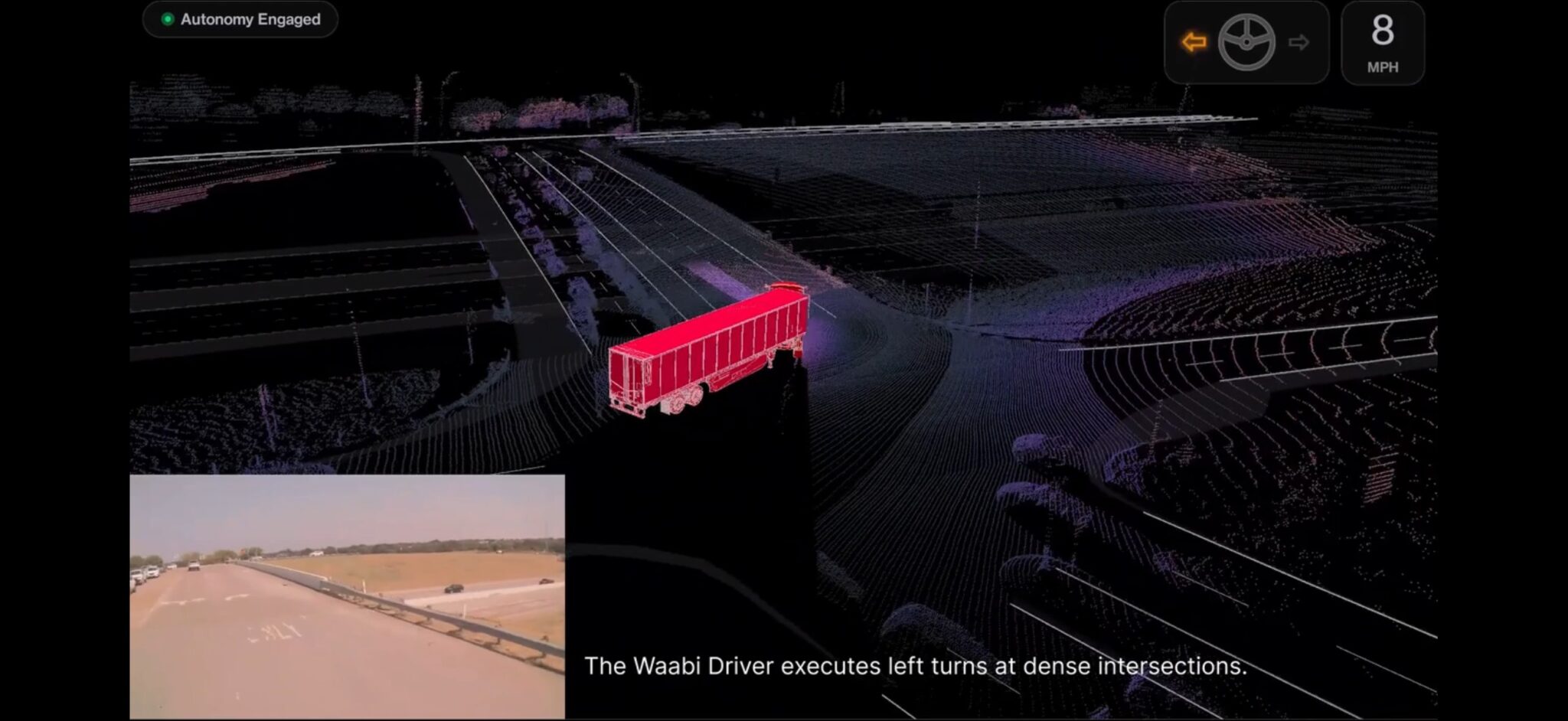
Waabi said its autonomous technology can successfully navigate not only highways but also more challenging surface streets.
“This represents a critical advancement that fundamentally changes the commercial possibilities for autonomous trucking,” the Toronto-based company wrote in a Nov. 25 blog post.

Waabi said the progress of its “Waabi Driver” system on surface roads during 2025 means that in the near future, “all shippers, not just a select few,” will be able to benefit from autonomous transportation.
“This model expands the serviceable market dramatically, removes barriers to adoption across the freight industry, and ultimately mirrors the way freight actually moves today — from shipper facilities directly to customer facilities,” the company said.
Waabi said thus far, most autonomous trucking companies have focused on a hub-to-hub model, which restricts service areas to fixed routes, primarily on highways. However, each year, more than 40% of miles traveled by tractor-trailers are on surface streets, representing nearly 84 million miles (135 million km).

Surface streets have a wider range of unpredictable conditions than highways, including complex intersections, varied traffic-light patterns, and a high density of pedestrians and cyclists.
“This means that all the intended features needed to remove the human driver are now implemented for both highway driving and surface streets,” Waabi said of its technological accomplishments.
In October, Waabi and Volvo Autonomous Solutions announced they had reached a milestone in their autonomous trucking partnership, successfully integrating the Waabi Driver with the Volvo VNL Autonomous.