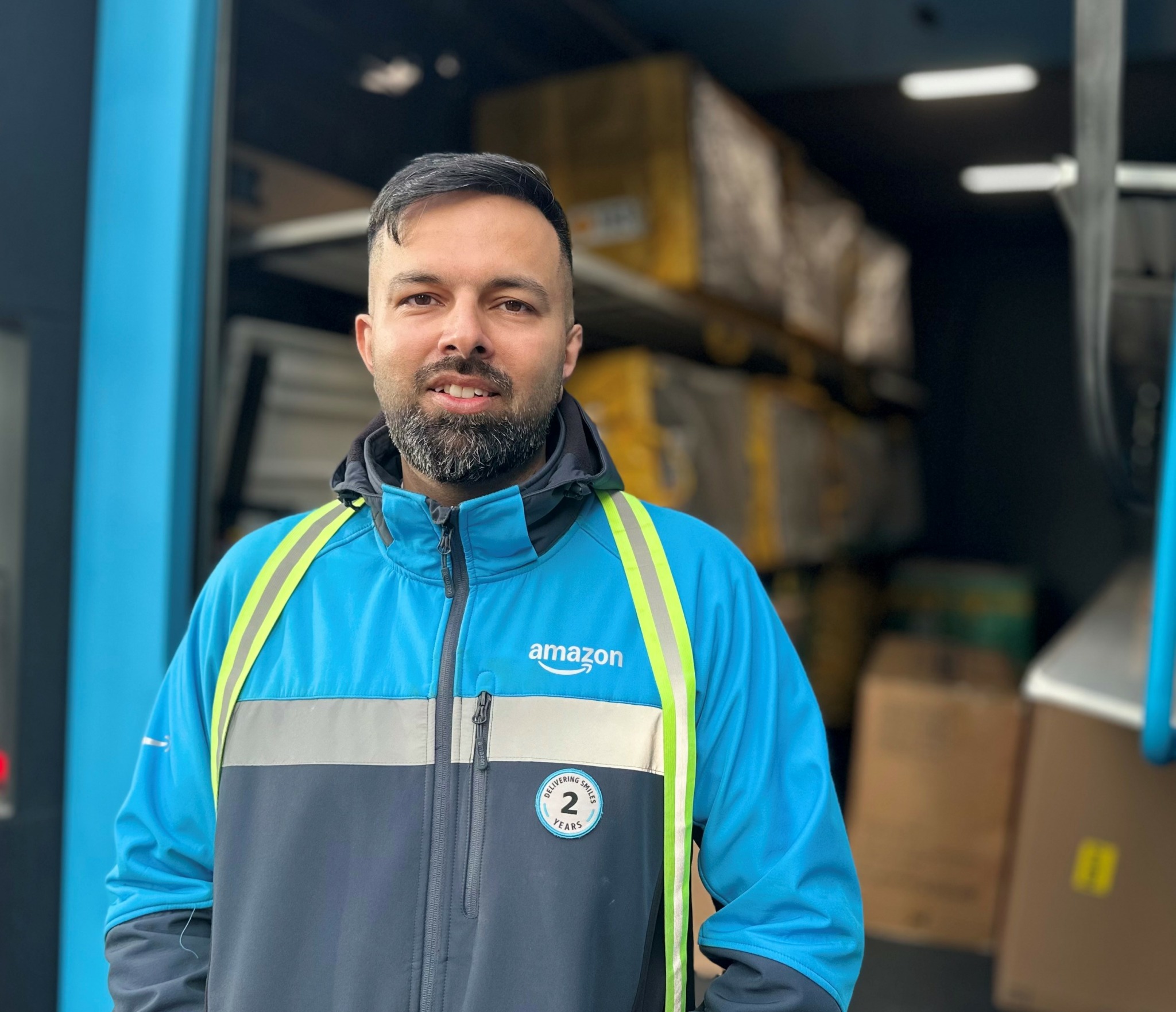
“Look at this,” Jasmeet Gill said to me, gesturing to his feet, which were planted firmly on the floor of the Rivian van as we were stopped at a red light.
Gill, an Amazon delivery driver in Greater Vancouver, was pointing out the near-one-pedal operation capabilities of the Rivian electric van, one of the cooler features for a driver recently transitioned from a gas-fueled van.

When the driver approaches a stop, they can simply let off the throttle and the electric van will bring itself to a stop, all while pushing power back into the batteries.
It’s a process called regenerative braking, and it greatly reduces the use of the brake pedal when driving. For a delivery driver making hundreds of stops a day in a congested city, it’s just one of the features that make driving that much easier.
And it’s just one of the features drivers like about the Rivian 700 electric cargo vans, 50 of which were recently deployed by Amazon in Vancouver. It’s part of a broader order of some 100,000 Rivian vans that Amazon has promised to put into service by 2030.
Already about 30,000 of those electric vans have been deployed across the United States, but the 50 that took to Vancouver-area roads late this year are the first in Canada.
Amazon selects the markets into which to deploy the vans, a decision primarily driven by routes, charging infrastructure preparedness, climate and other considerations.

Built with input from Amazon
“We’ve got service centers in Vancouver. We also have service centers in Toronto, Calgary and Montreal, as well,” said Erica Tsypin, head of strategic partnerships and B2B sales with Rivian.
The relationship between Amazon and Rivian is a close one, as you’d expect would be the case, given the 100,000-vehicle commitment. Amazon was very much involved in the design of the van, which was built to reflect the operational realities of the fleet and the needs of its drivers.
“We worked very closely with them during the development and design phase,” Tsypin said of Amazon in an interview with trucknews.com. “As we were building the vehicle, we leveraged a lot of data and learnings from what their drivers like, how their drivers use the vehicles and what are some of the pain points that their drivers experience? And based on that feedback, we were able to develop both the hardware and the software to support a safe, productive and sustainable vehicle for them.”
Amazon came to the table with a set of demands, and safety was among them.
“These drivers are in and out of the vehicles, potentially hundreds of times a day. So, making sure, for example, that we have an ergonomic way for them to do so, thinking about step height, the grab handles. As a driver, you put the vehicle in park and the bulkhead door behind you automatically opens,” Tsypin explained.
I got to experience that when Gill pulled up to our first drop on the morning of Dec. 9 on Hazelbridge Way in Richmond, B.C. As Gill stopped the van in front of an apartment complex, he put on the hazard lights and put the van in park. As promised, the bulkhead door behind me slid open, allowing Gill quick and easy access to the spacious cargo compartment where some 240 packages were stacked neatly on an integrated shelving system, awaiting delivery.
After collecting the packages to be delivered to the complex, Gill walked through the spacious driver compartment, exiting on the passenger side, to make his delivery.

Amazon’s DSP model
Amazon Canada uses delivery service partners (DSPs) to deliver its packages. It could be a single-van owner-operator or a fleet with dozens of vans and drivers.
Gary Brar is owner of Rev Couriers Services, one of two Amazon DSPs operating the Rivian vans. His fleet has 25 of the initial 50 Rivians, in addition to the 35 gas vans the company previously operated.
“They set it up like a pilot program,” Brar told trucknews.com. “We had a designated [Rivian] team that was available for us with any questions that we had at any point. They helped guide us through and still to this day, if we have any questions with maintenance or any of the technology that’s in here, they’re always available to help us out.”
Amazon’s DSP model allows companies to utilize their own vehicles, but in the case of the Rivians, Amazon owns the vans and leases them to the delivery partner.
Amazon has installed 50 Level 2 chargers at its DYV1 delivery station. Hector Balgos, DYV1 site lead, explained that between 45-50 vans are dispatched from the facility each morning, in waves beginning at 9:50 a.m. and every 20 minutes thereafter. The fleet can expand to 60 to 65 vans in peak seasons, with each typically loaded with 230-240 packages. It takes drivers about 10 hours to complete their route, after which they return to DYV1 and plug in for overnight charging. It takes about six hours to fully charge the vans.

Driver reaction
Before the arrival of the Rivian electric vans, DSPs typically operated gas-powered Ford Transits. Brar said drivers have quickly embraced the change.
“They love the vans,” he said of the Rivian 700. “There’s plenty of cargo space. There are sensors built all around the vehicle with 360-degree cameras all the way around. They feel safer.”
Previously, drivers would load their delivery routes onto their own devices and use their smartphones for navigation. Now, in-dash systems with large displays guide them, and 360-degree views from above or around the van make it easier and safer to navigate crowded streets.
Drivers mostly appreciate the additional cargo space; the Rivian 700 boasts 652 cu. ft. (18.5 m³) of cargo area, with a large rear roll-up door measuring 52.1 inches (1,323 mm) wide and 74.3 inches (1,887 mm) high.
“The cargo space, as you can see, is a lot bigger,” Brar said during a walkthrough of the Rivian. The racking system and additional space in the cargo compartment have made it faster and easier for drivers to find packages, he explained.
The rear door automatically closes when the driver (and specifically the key fob) have exited the vehicle, which frees up time for the driver and also reduces the risk of package theft during stops.
Currently, drivers are delivering the same number of packages as they did previously using the Transit, but they claim to be able to do so more efficiently thanks to the additional space. They also like how the vehicle performs.

A smoother, safer ride
“We’ve had really good feedback,” Brar said. “They like the drivability and how smooth they are, and just feel safer when pulling into tight areas. They’re able to see the bird’s eye view and get out of situations in tight areas better than before.”
Kevin Charlebois, driver trainer with Amazon, has trained each of the Rivian drivers on how to drive the vans efficiently. This includes taking advantage of regenerative braking to extend range.
Other teachings include adjusting to the larger size of the vehicle and also understanding that heating and cooling the cabin requires a different mindset. He said drivers typically become adept at operating the EV after about 45 minutes on the road in one.
As for heating and cooling, Tsypin acknowledged it’s challenging to maintain a comfortable cabin temperature in a large cargo van without depleting battery power. So Rivian took a new approach to driver comfort.
“Our team developed a patented multi-climate seat so that the seat actually heats and cools the driver,” she explained. “It’s more of a targeted approach to heating and cooling rather than just blowing air everywhere. You’re actually focusing on the driver and keeping them comfortable during different weather conditions and it’s a more energy-efficient way of keeping them comfortable.”
The steering wheel is also heated.
No more fueling up
One of the drivers’ favorite features, said Balgos, is that they no longer need to fuel up at the end of a driving shift. Previously, drivers were expected to fuel up at a Shell station, and occasionally that meant going off route at the end of a long day and spending 10-15 minutes at the pump.
“It saves us a lot of time and time is money,” he said of not having to fill up during a shift. “This time that we can save, it’s more time for us to deliver more packages.”
Rivian is also able to help Amazon with routing or charge scheduling based on the telemetry that can be pulled from the vehicle.
“We are able to collect thousands of different data signals from the vehicle,” said Tsypin. “There are many data signals that we share with Amazon for them to be able to improve their operations.”
As for performance in extreme weather, not a major concern in Vancouver, perhaps, but in other parts of Canada, Tsypin said the Rivian van has proven itself in harsh conditions.
“We originally launched a program here in Chicago,” she said. “So yes, we are in climates that are very similar to some of the harsh Canadian climates.”

On the road
Back in the van with Gill, cargo compartment neatly loaded with 240 parcels to be delivered to 53 locations, we chatted about the van as we waited for our turn to depart the sorting station. A horn sounded, and the vans began noiselessly filing out of the facility for the day’s work.
Gill told me he typically delivers 220-230 packages but in the Christmas season it can spike to 300 or more. With several weeks under his belt with the Rivian, Gill has concluded it’s a major improvement to his workday.
He said it’s easier to get out of the driver’s seat and to move around the cab thanks to the flat floor and wide-open passenger area (when the foldable jump seat isn’t occupied by a curious editor).
Range anxiety isn’t an issue for Gill. The van is said to travel 250 km (155 miles) on a charge, and Gill’s route is typically only 80-90 total km (49-55 miles). Maneuverability is easier thanks to the camera system, he added, and the ride is quiet. He finds the heating sufficient but wears a warm coat. Getting large packages out of the Rivian is also easier than it was in the Transit, Gill pointed out.
With Amazon’s promise to deploy 100,000 Rivian vans by 2030 and to be a net-zero carbon emission company by 2040, there will no doubt be more of these silent sleighs delivering Christmas gifts to Canadians in the future.
Rivian 700 spec’s:
Height: 114.8″ (2,917 mm)
Wheelbase: 187.0″ (4,750 mm)
Ground clearance: 7.4″ (188 mm)
Cargo area: 652 cu. ft. (18.5 m³)
Cargo area length: 166.8″ (4,237 mm)
Payload: 2,258 lbs (1,024 kg)
Curb weight: 7,242 lbs (3,285 kg)
Powertrain: Single-Motor Front Wheel Drive
Battery: LFP (Lithium Iron Phosphate) 100 kWh battery pack
Horsepower: 320 hp (235 kW)
Torque: 299 lb.-ft. (405 Nm)