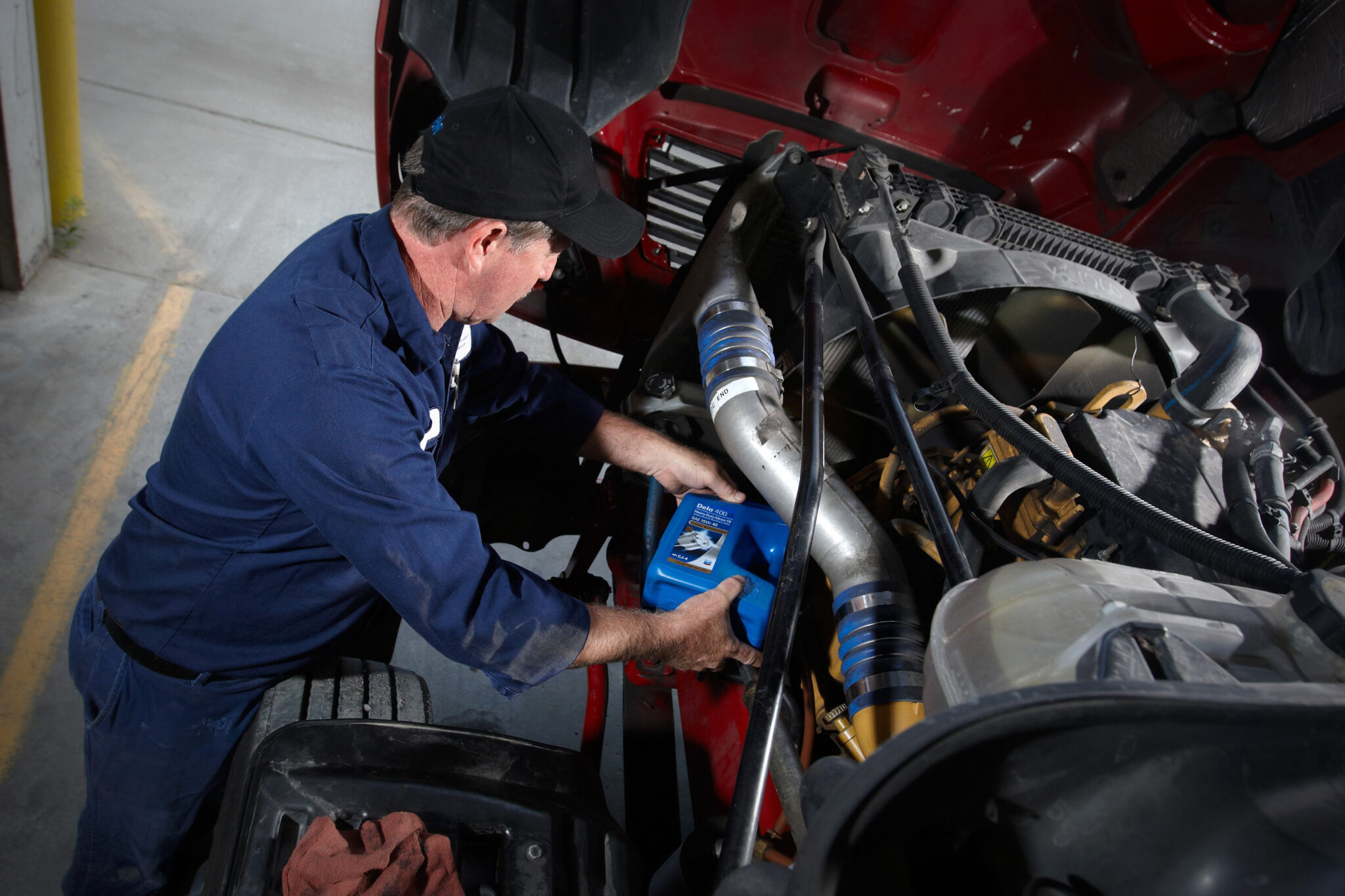
A new generation of heavy-duty diesel engine oil is headed our way in the next 12 to 18 months. Known currently as PC-12, or Proposed Category 12, the oils under development through the American Petroleum Institute (API) will meet the needs of cleaner, more efficient truck engines coming in 2027.
Two new oil categories will eventually emerge from this development process and will be designated CL-4 and FB-4.

CL-4 oils succeed the current CK-4 oil with updated limits for emissions-system protection, oxidation stability, and wear control, and will be backward compatible with older diesels.
FB-4 oils succeed current FA-4, and are a more fuel-efficient formulation, likely of a lower viscosity. These oils are meant exclusively for next-generation 2027-and-beyond engines designed for lower-viscosity oils. FB-4 oils will not be backward compatible with older engines.
When the PC-12 development is complete and the newer CL-4 and FB-4 oils take their position in the market, the previous generation CK-4 and FA-4 oils will be phased out — following a transition period.
“I don’t see a world far into the future where we have multiple categories in the aftermarket,” says Karin Haumann, OEM technical manager, Shell Global Solutions, and chairwoman of the API new-category development team.
“Nobody will be able to maintain two full portfolios of CK-4 and CL-4 for, for the same reason you don’t see CJ-4 oils prominent in the market today. CK-4 is compatible with CJ-4. Once the transition is complete, those will be the prominent oils on the market.”

EPA27 demands
This move is being driven by sharply tougher U.S. and California emissions standards requiring significant reductions in nitrogen oxides (NOₓ) and particulate matter. Engine makers are redesigning hardware to run hotter, leaner, and under higher pressure — conditions that today’s CK-4 and FA-4 oils weren’t designed to handle.
“The new categories are driven by requests from the engine manufacturers for us to make some improvements to the oil to help them facilitate the hardware changes they are making to comply with the EPA regulations that come out in 2027,” Haumann told trucknews.com
The new category will tighten limits on key chemical elements such as sulfated ash, phosphorus, and sulfur in the oil. These can degrade emissions system components, including diesel particulate filters (DPF), selective catalytic reduction (SCR) systems, and diesel oxidation catalysts (DOCs).
The challenge comes in maintaining or improving the oil’s performance while reducing levels of these key ingredients.
Reducing phosphorus, for example, helps protect emissions systems but makes it harder to maintain wear and oxidation protection — forcing formulators to innovate with new additive technologies.
Sulfated ash is the residue of metallic additives that provide wear protection, detergency, and alkalinity. Reducing it protects exhaust aftertreatment systems but challenges oil formulators to preserve engine durability using new ashless chemistries.
“Some of the chemistries we use for cleanliness and wear and dispersants and such can aggravate the aftertreatment systems if the oil is burned in the combustion chamber,” Haumann explains. “Those inorganic compounds don’t break down completely. They can deposit onto the DPF in the form of ash. One of the EPA targets is increasing the life of the DPF and reducing regeneration cycles. That’s one of the challenges we are working with.”
Consumer impact
Oil suppliers were handed a very demanding request by the engine makers. In addition to incremental improvements expected in a new oil generation, EPA has extended the “useful life” of the engine and emissions system from 435,000 miles to 800,000 miles (696,000 to 1.28 million km). The engine makers must warranty their products for nearly twice the useful life.
They need an engine oil that can deliver that key requirement.
Among the other changes we’ll see with these new oil categories are improved oxidation resistance to support longer drain intervals and higher operating stresses, and lower viscosities (ie. xW-20) for improved fuel economy.
The rigorous EPA demands will force fleets to be more selective in the engine oils they choose to use. The development demands may leave some suppliers at the door, reducing the supply of suitable product.
“Customers and end-users should be mindful of products labeled as ‘suitable for use’ — not only in relation to OEM specifications but also in terms of meeting API standards,” cautions Doris Gusic, brand marketing manager, commercial and industrial, Wakefield Canada, a distributor of Castrol lubricant products. “It’s important to recognize that many smaller lubricant manufacturers will not have the resources to formulate fully approved products at lower price points, which can impact performance and compliance.”

Where are we with EPA27?
Given the confusion surrounding the on-again/off-again roll-out of the EPA27 emissions regs, it’s reasonable to ask if this new oil category will come into effect as planned in January 2027.
The answer is yes; it will. The engine makers are proceeding with development of the new engines, and they will need compatible oils.
Haumann told trucknews.com development of PC-12 began back in 2021, in parallel with the changes engine manufacturers were making to meet new emissions targets.
“This is a technical improvement that API has been tasked with, so we’re proceeding full steam ahead with what was asked for,” Haumann says.
Whether there will be as much of a need for it remains to be seen. That’s a political question. Haumann stressed that API and the oil suppliers will be ready.
“These changes take a long time. We’ve put a lot of work into this. That train has left the station. This isn’t something you can undo on a whim,” she stressed.