Cube robotics pioneer AutoStore presented some eye-catching innovations at an event in Nice in October. Paul Hamblin talks to Russell Holmes, Sales Director, UK and Ireland, about the company’s ability to deliver higher throughput and scalability for its customers.
Think AutoStore and you automatically think Cube – the revolutionary and unstoppably successful high-density AS/RS from Norway that brought to warehouse logistics a grid of stacked bins accessed by robots at the top of it. The famous result was automated, faster, more efficient fulfilment bolstered by optimised use of precious warehouse floor space.
It began way back in 1995 – today, AutoStore has over 1700 systems installed in over 60 countries and continues to break new ground, growing its community of employees, partners and customers.
“The vision is simple but powerful,” says Russell Holmes. “We want to store and move things for everyone, everywhere. It’s about developing robotics and advanced software to automate and also orchestrate order fulfilment.”
Everything starts with the customer, he says. “The fulfilment industry is changing so quickly,” he reflects. “Speed and flawless customer service are non-negotiable. Faster delivery, broader assortment of products and superb service, no matter the disruption, are all expected. Our customers face labour shortfalls, volatile supply chains and rising costs beyond their control. They need to move greater volumes through smaller spaces, with fewer human resources, to tighter deadlines.”
The company’s latest response to these challenges is an impressive array of new features, launched at an event in Nice in October.
Automatic case loading and unloading
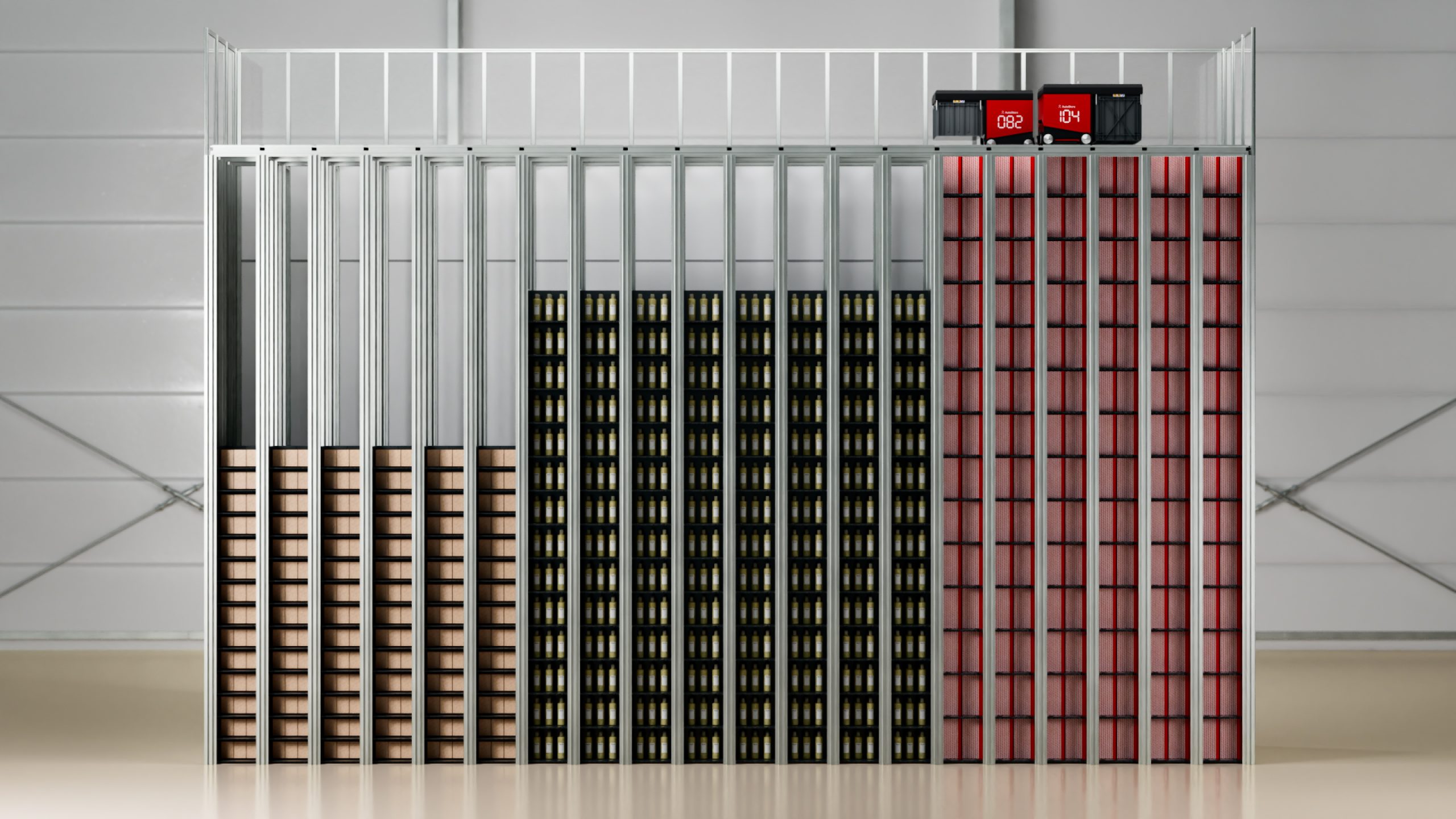
The headline act is AutoCase, which automates the loading and unloading of full cases, enabling cases to be moved into storage and then individual items (or ‘eaches’) to be picked from those cases.
“High throughput and high scalability are our mantra,” says Russell Holmes. “AutoCase enables case handling and piece picking to be combined in one flow, and that keeps throughput high and shelves stocked even at peak demand.”
Fully automated case induction and extraction offers the benefit of eliminating manual handling of heavy loads, not only reducing labour costs but enhancing warehouse safety.
AutoCase also promises the versatility demanded by modern logistics, able to adapt and evolve to support use cases in everything from high-velocity fashion releases to seasonal grocery surges and large-scale retail volumes. “It also drives operational excellence, because advanced dynamic bin allocation intelligently utilises every cubic inch of your warehouse,” adds Holmes (pictured, below).
Bin flexibility
Scalability and throughput are obvious benefits behind FlexBins, another noteworthy innovation presented at Nice. Up to now, AutoStore’s three bin sizes each required their own grid, because different dimensions could not be integrated in a single grid; if a customer wished to deploy more than one size, they would need add-on grids. No longer – FlexBins enables all three sizes to be integrated within a single system. “Once again, it’s about listening to our customers’ needs to service wider product range capability in faster time frames,” he explains.
SKU variety and breadth are enhanced. “For customers, FlexBins mean you can combine small, fast-moving items such as accessories or electronic components with larger, bulkier or irregularly shaped items, such as shoeboxes. Picking, packing, buffering and kitting will all benefit,” he adds.
Meanwhile, CarouselAI, the AI-powered robotic picking workstation launched in spring this year, has been further enhanced to enable faster retrieval, lighter item handling and outbound routing options.
Further innovations aimed to cut implementation time and costs of ownership include improved and more cost-effective sprinkler systems, laser scanning and shim technology eliminating the need for costly floor grinding prior to fitting, and CubeDeploy, a single installer for faster, simpler software updates.
Holmes is confident about AutoStore’s ability to match the needs of even the most complex warehouse environments (a ‘Frozen-Only’ grid is also now available) as well as its trustability. “The first AutoStore was deployed 20 years ago and that first system is still operating at above 99.7% uptime and availability today,” he says.