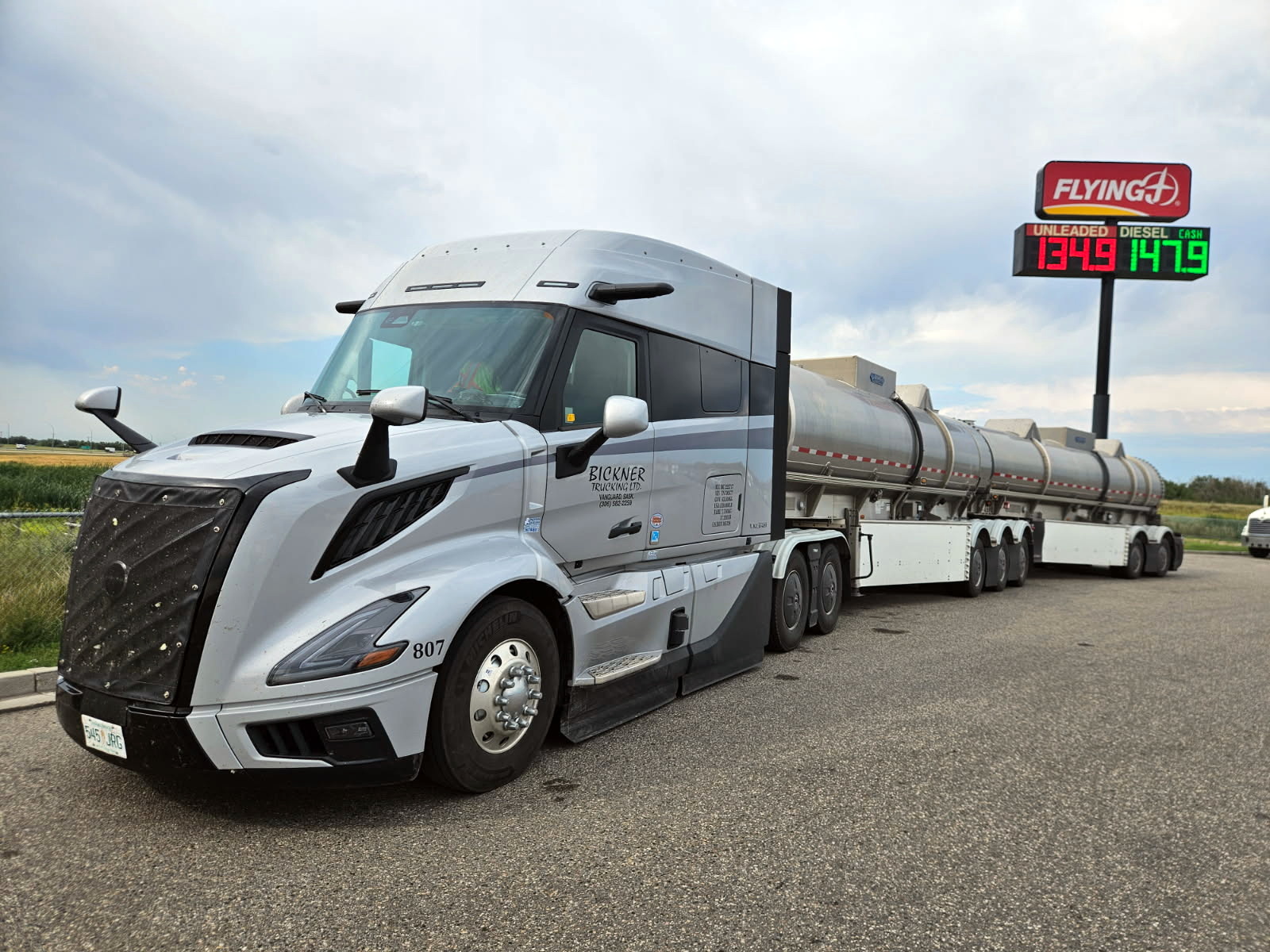
Fuel economy gains in trucking are usually measured in fractions of a mile per gallon. That’s why John Bickner was more than a little surprised — and excited — when the newest trucks in his fleet started delivering nearly 3 mpg better fuel economy than his long-standing fleet average.
Two years ago, the top performers in his fleet averaged 6.8 mpg (Imperial), or about 5.7 mpg U.S. That wasn’t stellar by broader industry standards, but it was almost 2 mpg better than that achieved by some of the lease-operators working with him at the time. They struggled to break 5 mpg Imp.
As of late September, after the most recent 200 days in service, Bickner’s newest trucks are averaging 9 mpg Imp. That’s equal to 7.5 mpg U.S., 31.4 L/100 km, or 3.19 km/L. The lifetime average for the truck, after 15 months, is 8.54 Imp. (7.14 mpg U.S.)
That kind of fuel economy would be respectable for a typical U.S. truckload carrier. But Bickner’s trucks aren’t pulling van trailers at 67,000 lb. (30,454 kg) gross vehicle weight. They’re hauling Super-B tankers at 140,000 lb. GVW (63,500 kg).

Who is Bickner Trucking?
Bickner Trucking, based in Vanguard, Sask., is owned and operated by John and his brother Todd. Their fleet of 62 tractors and more than 100 trailers move grain and seed in hopper trailers and liquid fertilizer in aluminum tankers across Western Canada and the upper Midwest and Northwestern states.
After nearly 40 years in business, the company has earned a reputation as a tightly run, customer-focused operation with a spotless U.S. DOT safety record. The Bickners are also known for embracing the latest in powertrain technology — and it’s paying off.
Their trucks typically cruise at 60 mph (96 km/h), with an average logged speed of about 54 mph (86 km/h) on most highway runs. Idle time is held under 5%, and more than half its mileage — about 56% — is at full gross weight. The backhauls are often empty, which helps boost the average fuel economy. Still, Bickner told trucknews.com his fuel economy with a fully loaded Super-B is consistently around 7.5 mpg (Imp.).
As a bulk hauler, Bickner is paid by the ton. The more he hauls, the more he earns. Consequently, he’s laser focused on the TARE weight of his trucks. He knew the new tractors were going to come in a little heavier than his current sleeper trucks, so he decided to cut some weight from the trailer. Complicating matters, he wanted to add some aero devices to the trailer to further improve fuel efficiency.
“We couldn’t add weight just to increase our fuel mileage,” Bickner said. “The weight we gained on unit 740 we had to get back from the trailer.”

The trailers
The all-aluminum Super-B tankers were designed and built by Advance Engineered Products in Regina. They are about as light as they can be while maintaining structural integrity, but Bickner insisted on carving as much weight as possible from the B-train.
The engineering team started by redesigning the discharge piping and moving the box containing all the pumps and valves from the right side of the trailer to the center of the trailer. Bickner says weight savings from removing all the bracketing and supports came up to nearly 300 kg (660 lb.).
“The box stuck out into the wind from under the trailer with its big square front. It was an aero nightmare,” he said. We open both sides of the box, we can have nice air flow for servicing.”
With the box in the center, located between the landing gear bracing and the trailer bogies, Bickner added a V-shaped device to route the air around the box. He also added a V-shaped foil to the landing gear brace to help with the air flow there, too.
Finally, he added an extender to the rear of the lead trailer to help close the gap between the two tank trailers, and a lift kit for the forward trailer axles to reduce the rolling resistance of the empty unit. He also added a set of FlowBelow wheel fairings and wheel covers.
“Those modifications have really helped, but it’s difficult to say exactly how much. The V-boards have really tamed the 10-and-2 winds from getting under the trailers,” he says. “I think we might have found another 2% in fuel savings over the first trailer we worked on. I just haven’t nailed it yet.”
As an additional and unanticipated benefit, drivers can now unload the trailers from either side, thanks to the relocation of the discharge pumps.

The power units
Bickner is an avid online follower of several American drivers who have made a mission out of improving fuel efficiency — Joel Morrow and Henry Albert to name just two. Morrow is perhaps the most relevant as he runs Volvo power, like Bickner. When Bickner started following him, Morrow was running a steady 10 mpg U.S. (12 mpg Imp.) and flirting with 11 with his 80,000-lb. five-axle dry van units.
“I had been watching these guys for several years as they reported the gains they were making with different approaches. When I started doing the math I realized how much we were missing out on up here,” he said. “Taking what I had learned online, I was determined to build a truck and trailer combination with an 8.3 (Imp) average for a year — up 22% from our current 6.8 mpg average.”
Bickner has been buying Volvo products since the early ’90s, and has a long-standing relationship with his dealer, Shawn Hornoi at Sterling Truck and Trailer in Regina. Even with that, the folks in Volvo’s sales engineering department were slightly amused when Bickner told them he wanted a truck to pull Super-B trains with a 2.47:1 rear axle ratio.
At the time, that ratio had not been approved for that kind of weight. Bickner says he thinks the axle manufacturer stepped up and OK’d the idea.
Bickner Transport Unit 740 spec’s
- 2024 Volvo VNL 740 mid-roof
- Volvo D13TC 455/1850 with I-Torque spec’ (turbo-compound, I-See predictive cruise, Eco-Roll neutral roll-out)
- iShift 13 speed O/D
- Rear axle ratio: 2.47:1
- Fuel capacity: Single 150-gallon tank
- Optional equipment: PureFlow Airdog (removes entrained air from diesel fuel), Michelin wide-base single tires, FlowBelow wheel fairings and wheel covers, Dr. PreLoad bearing settings on truck and trailer, battery-powered APU, solar panels, centrifugal wheel balancers, Eco-Fins, and more.
One year in
As of late September, after 14 months and 142,000 miles (227,000 km) of service, the truck’s lifetime average fuel economy stands at 8.54 Imp. (7.14 U.S., 33.1 L/100 km or 3.02 km/L). That’s 3.5% better than the 22% improvement Bickner hoped for when he spec’d the truck and trailer.
“I track the performance of this truck very carefully,” Bickner says.
“We’re in top gear (overdrive) about 80% of the time with the engine turning at 998 rpm. The D13TC makes full torque right down to 900 rpm so there’s still room to pull down even further. When pulling into a strong headwind, the transmission often drops into 12th gear (direct) and keeps pulling at 1,260 rpm — where full torque and horsepower live.”
Not only is Bickner getting the fuel efficiency he wants, but his drivers are happy with the performance of the trucks. They love the moments when their full-aero trucks and trailers just walk away from guys in classic-styled trucks with big 550-600 hp engines and 3.36 and 3.55 gears when fighting the high winds out on the prairies.
One of his light-weighting strategies was eliminating one fuel tank. Dropping that 150-gallon tank reduced the TARE weight by about 1,000 lb. (454 kg). The trucks typically run a 950-km (590-mile) trip, so the drivers were at first a little leery about losing half their fuel capacity. But it was needless worry. Because of the improved aerodynamics and the fuel-sipping engine, that single tank is still about half full at the end of the day.
“The drivers love that,” he says. “They only have one tank to fill, so no more walking around the truck topping off the tanks. It cuts their fueling time in half.”
Bickner has since brought on three more similar spec’d Volvos — this time they were the new VNLs. They are performing as well or better than the original units. Bickner says the new VNLs are showing gains of 10-11% over the legacy trucks.
On one trip this past summer, Unit 809 averaged 10.91 Imp. (9.09 U.S.) on a loaded-one-way trip. Actual fuel economy was 7.63 Imp on the loaded leg (110,000-lb GVW) and 14.18 Imp. on the empty leg.
“I know, that’s just one trip on a nice calm day with hardly any wind, but how can I not brag about that,” he chuckled.

Key takeaways from Bickner’s experience
There’s much to be learned from Bickner’s experience with this slightly radical approach to powertrain spec’ing, not the least of which was overcoming the “old ways” of spec’ing for heavy haul.
It took some cajoling to get the OEM to approve the rear-end spec’, but in the end, he got the green light. He’d done the math and had the trip data to show most of the work the trucks would do would be on flat prairie — albeit with some significant headwinds some of the time.
He extensively coached his drivers on the new technology and was upfront and transparent about the expected benefits. While it took some time to get drivers comfortable with the new spec’, he hasn’t had a single complaint.
The fuel savings and larger payloads combined have freed up more money for better driver pay.
“Good pay and good equipment lead to better driver retention,” he reminded us.
On the front end, he extensively researched new and emerging technology and was keen on bringing it into the fleet based on results he saw from other users.
On the back end, he closely monitored the trucks’ performance to ensure he got the most from his investment.
Bickner’s next project is to improve the aerodynamics of a grain hopper trailer. They are like bricks, he says. He’s working with his trailer partners as you read this. He recently put into a service a Volvo VNR 300 day cab with a 425-hp D11 engine for local work. Yes, he’s pulling loaded Super-Bs with an 11-liter engine and already reaping a whirlwind of benefits — specifically about three metric tons more payload.
The truck and trailer tip the scale at just 15,380 kg (33,836 lb). Cha-ching!