You may know Hendrickson International as a suspension manufacturer, but the company’s reach into the truck and trailer equipment market expands beyond suspensions.
That was the message during a recent press event, themed ‘Beyond Suspensions,’ that included visits to two Hendrickson factories in Ohio. The company will next year mark the 100th anniversary of the walking beam suspension that its founder, Magnus Hendrickson, invented.
During its recent event, Hendrickson highlighted its role in four areas: brakes; active analytics; genuine aftermarket parts; and tire inflation.
Aftermarket parts
Dave McCleave is Hendrickson’s director of aftermarket. Choosing genuine aftermarket parts is crucial to maximize uptime and ensure the continued performance of the originally spec’d equipment, he noted.
Choosing genuine aftermarket parts allows operators to maintain the benefits that come from the design, modeling, lab testing and validation of the original components those parts will replace.
The integration work has already been done, so those parts are seamlessly installed on existing equipment without any performance degradation. Hendrickson is also able to lean on its experience with original parts to bring aftermarket parts to market much more quickly, utilizing the same processes as with original parts, including the use of lab-based shaker machines.
Hendrickson has brought to market some cleverly engineered parts over the years. Its ZMD (Zero Maintenance Damping)-equipped suspensions eliminate shocks, which are prone to wear and failure.
“We understand what the pain points are,” said McCleave. “Over the years, one of the pain points was shocks. Most fleets will tell you on a steer axle, they’ll change the shock out on a regular basis because those tires on the front axle are brand new and they’re expensive. They don’t want them to wear out prematurely. On the drive axle, if they’re bad, they’ll change them.”
ZMD eliminates this pain point by replacing traditional shocks with a sealed, pressurized piston and bellows, allowing the controlled exchange of air pressure and eliminating wearable components without degrading damping over time.

Hendrickson is also the producer of the Motor Wheel brand of CentriFuse drums. McCleave said they’re the lightest-weight brake drums in the industry, saving a fleet 232 lb. (105 kg) when equipping them around an entire tractor-trailer.
Unlike competitive models, it’s not a cast drum, McCleave explained. Rather, it’s made of cast material, which is fused to a steel ring, enabling the weight savings without compromising strength.
“Cast drums can crack and break,” McCleave said. “This steel jacket won’t break like that.”
The steel jacket is also better at dissipating heat, he added. Hendrickson is engaging preferred retailers who act as ambassadors for the brand, stock appropriate inventory, and learn the ins and outs of how the components and systems work.
McCleave said there are also 11 district sales managers in the United States and Canada to support outside parts sales reps and dealers, in addition to 14 regional service managers who provide hands-on training to distributors, dealers and fleets.

Tire inflation
Matt Wilson, vice president and general manager of Hendrickson’s Vehicle Technology Group, gave an overview of the company’s automatic tire inflation system (ATIS), Tiremaax. Tire inflation is a major concern among fleets, and for good reason.
Wilson shared that:
- One in five trailers is operating with a tire underinflated by 20 psi or more;
- Overinflation can see tire life reduced by 7-15%;
- 25% of trailer duals have mismatched air pressures of 5 psi or more;
- Van and reefer trailers are driven empty about 34% of the time, while tankers are empty about 38% of their total miles.
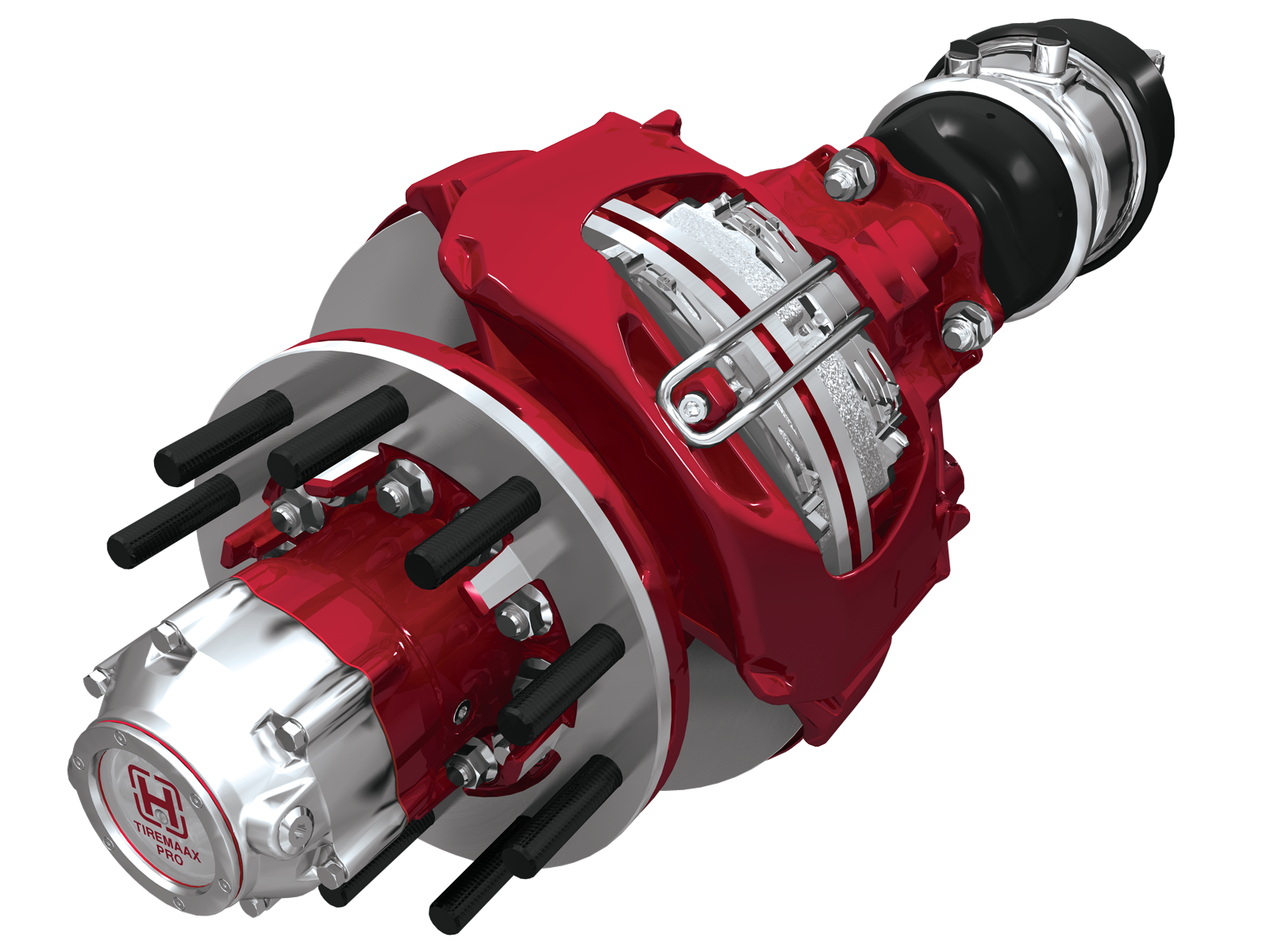
Typical tire inflation systems address only underinflated tires, Wilson noted. However, the Tiremaax line has been expanded to address each of the above scenarios. Tiremaax CP provides inflation, Tiremaax Pro adds inflation relief for overinflated tires and mismatched duals, and Tiremaax Pro-LB makes load-based adjustments on the fly so tires are always inflated to the optimal pressure for the load they’re carrying.
“A lot of trailers out there might be running at 50% load capacity and in those applications, they should run at 75-80 psi,” he said. “Nobody’s doing that. Everybody has to set their tire pressure at a value equal to the maximum load they anticipate.”
Wilson said the company has also taken a unique approach to the system design. The vent, for example, is attached to the axle rather than the wheel-end, to prevent contamination and damage.
“We are passionate about the fact that having a hub cap vent is not the best solution,” Wilson said.
Hendrickson is currently redesigning its controller to make it easier to operate and more durable. The new controller should hit the market next year.

Braking
Jeff Morris, director of axle, brake and wheel-end systems, provided an update on Hendrickson’s braking product line. While many may not think of Hendrickson as a brake manufacturer, the company has installed more than 12 million brakes over 30 years.
It operates the Hendrickson, Brunner and Motor Wheel brands, providing the industry with brake shoes, cam shafts, slack adjusters, brake drums and air disc brakes (through a partnership with Wabco).
This year marks an environmental milestone, as copper-free brake pads — containing less than 0.5% copper — are now required.
“Reformulation has been a big undertaking from friction manufacturers in the industry,” Morris noted, adding fleets should be mindful of the product they’re spec’ing since not all suppliers will have developed a suitable formulation when removing copper content.
Morris noted 80% of trailers today still run on drum brakes.
“They’ve been around forever, the technology is very mature and cost-effective,” he reasoned. “There is a wide variety of product that can suit most applications from 22.5- to 17.5-inch wheels and they’re relatively easy to maintain. Most fleets have the skills to maintain foundation drum brakes.”
Air disc brake adoption has been driven by their better performance and resistance to brake fade as well as an expected reduction in roadside inspection violations. (It’s easier for inspectors to spot violations on drum brakes).
But disc brake adoption on trailers has flatlined; some fleets are deterred by the higher price point and maintenance costs.
Among its brake products is the HXL7 with outboard mounted rotor, which allows technicians to service the rotor without removing the wheel-end.
Looking to the future, Morris said Hendrickson is working on brake sensors that will alert fleets when pads are worn out. Continuous wear sensors will allow them to better schedule maintenance. These advancements will be enabled as trailers become smarter and better able to convey data collected to telematics platforms and into the hands of fleet decision makers.