
The City of Boston lit its official Christmas tree on Boston Common this week, but it’s a celebration that shines far beyond the holiday season.
The tree is a gift from the people of Nova Scotia, commemorating a time when the people of Boston rushed aid to Halifax in the days following one of the worst disasters in Canadian history, the 1917 Halifax Explosion.
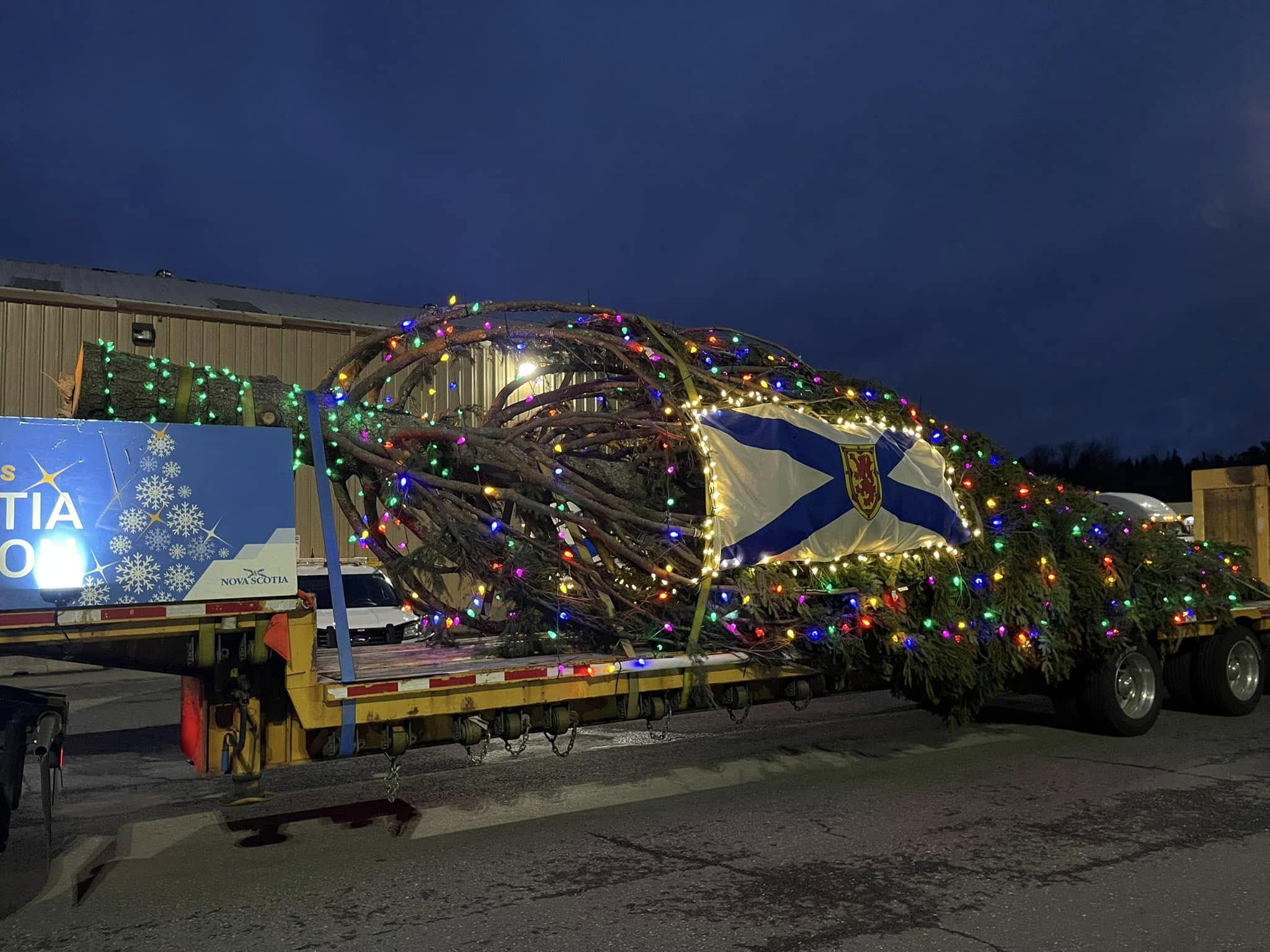
The tree, a 45-foot tall, 45-year-old white spruce harvested by private owners, Ronald and Claire Feener of Lunenburg County, made the 700-mile (1,120-km) trip to Boston late last month. It made the trip secured to a trailer hauled by a 1999 Western Star driven by Nova Scotia Department of Public Works Employee, Blake Sarty. This year marked the truck’s 24th trip to Boston with the special cargo.

A gift rooted in tragedy
On the morning of Dec. 6, 1917, the French munitions ship SS Mont-Blanc collided in Halifax Harbor with the Norwegian vessel SS Imo. Minutes later, the Mont-Blanc’s volatile cargo ignited, triggering what remains the largest human-made explosion prior to the nuclear age — a blast with the force of nearly three kilotons of TNT.
Nearly 2,000 people were killed, another 9,000 injured. Entire neighborhoods were reduced to splinters. Then, as if to compound the devastation, a fierce nor’easter swept in, burying the city in blinding snow and freezing temperatures.
Word of the catastrophe traveled fast, and within 24 hours, help arrived from the United States. Boston dispatched two relief trains loaded with doctors, nurses, medical supplies, and equipment for a 500-bed emergency hospital. The Boston Symphony held a benefit concert just 10 days after the disaster, and donations from across Massachusetts continued to flow north.
To show its gratitude, Halifax sent a Christmas tree to Boston the following year. The gesture lapsed over time, but in 1971 Nova Scotia revived the tradition. Since then, the “Tree for Boston” has become an annual symbol of friendship, remembrance, and shared resilience.

The road to Boston
Once the tree is selected, the logistics fall to veteran coordinator Sheldon Garland, who has been involved in the project since 2014.
“Once they pick the tree, I’m responsible for all the logistics, the crane, the trucks, everything it takes to get it to Boston,” said Department of Public Works coordinator, Garland.
This year’s journey began with a public send-off in Halifax, including the Nova Scotia Power Parade of Lights, where the tree was fully decorated and lit while laying on the trailer. Garland and the Public Works transport team cut the tree on Nov. 12, displayed it in the parade on the 15th, and then started the overland trek on Nov. 16.
As they crossed New Brunswick, a snowstorm set in — fitting, perhaps, for a tradition born from a historic blizzard. “It snowed pretty good up there,” Garland told trucknews.com. “The tree looked pretty awesome going through with the snow.”
The convoy overnighted at Dysart’s Truck Stop in Bangor, Maine, a popular stopover for trucks heading north and south to and from Atlantic Canada.
“We leave it lit up all night, and people take pictures of it,” said Garland. “The next night the tree stood glowing outside a fire station in Billerica, Mass., drawing families at all hours.”
The convoy rolled into Boston on Nov. 18 under a police escort. Large crowds were present as the tree was unloaded and erected on the Boston Common, where it has since been decorated and prepared for the official lighting ceremony.
Interest in the tradition has grown, Garland said, both in Nova Scotia and along the route.
“You’d be surprised — when you get into Boston, even in Maine, people come up and say, ‘We just read the book on it, or we just saw the story.’ A lot of people know about it,” he said.

Lighting the tree, honoring the past
Boston’s annual tree-lighting celebration, is one of the city’s signature holiday events, featuring performers, food, fireworks, and guests from Nova Scotia, including Nova Scotia Premiere, Tim Houston. The ceremony is broadcast live on city television, drawing thousands of spectators.
For Garland and his team, the journey is more than a transport job, it’s a yearly reminder of shared history and gratitude.
“People are always thanking you,” Garland said. “It’s pretty cool.”