Industry leaders at Transporeon’s Amsterdam Summit late last month heard a compelling case for balancing immediate operational gains with long-term digital transformation, writes Peter MacLeod.
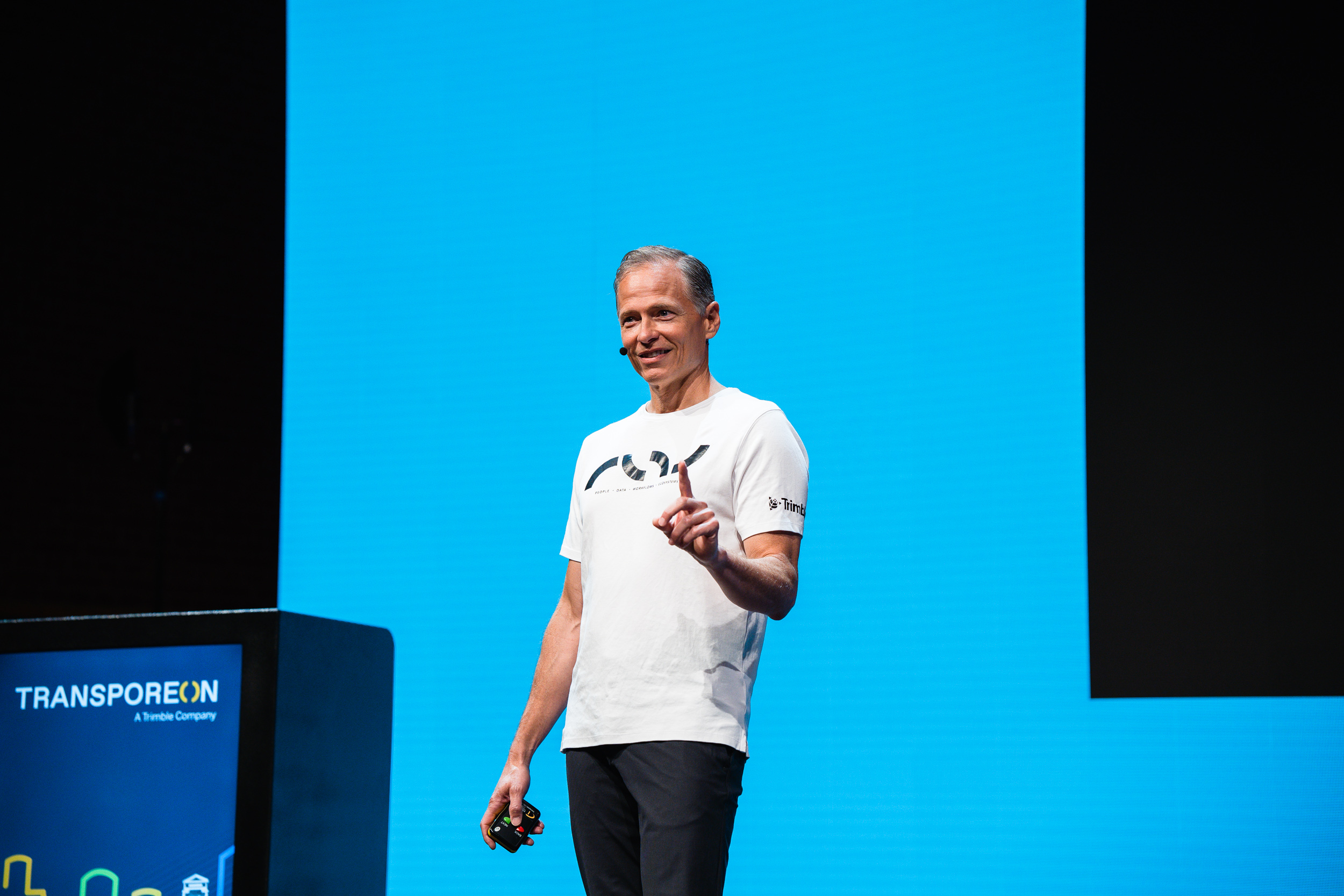
With global freight volumes set to triple by 2050, logistics executives face an unprecedented scaling challenge that traditional approaches cannot solve. Speaking to supply chain professionals at the Summit, Trimble’s CEO Rob Painter (pictured) outlined a strategic framework centred on what he calls “compound optimisation.”
The concept draws from financial theory: just as small percentage gains compound exponentially over time, marginal daily improvements in logistics operations can deliver transformational results. “A 1% daily improvement across your network translates to 37-fold enhancement over 12 months,” Painter explained to the Amsterdam audience of shippers, carriers, and service providers.
This approach addresses the fundamental tension facing logistics managers, which is delivering immediate ROI while building infrastructure for future demands. With urban populations expanding by 2.5 billion by 2050 and food requirements increasing 70%, the sector cannot rely on conventional capacity expansion alone.
The solution lies in connected ecosystems in which previously isolated tools share data and workflows. Transporeon exemplifies this integration, with a network spanning 1,400 shippers and 150,000 carriers, facilitating $55 billion (€47 billion) in annual freight spend.
AI serves as the critical multiplier in this equation. Recent implementations show AI-driven autonomous procurement reducing negotiation cycles from hours to seconds while optimising carrier assignments. One logistics partner achieved 80% real-time tracking visibility, eliminating check calls and redirecting resources to strategic activities.
The strategic imperative is clear: operators who embrace connected, AI-enabled platforms will capture the productivity gains necessary to meet tripling demand. Those relying on legacy systems risk obsolescence in an industry where marginal gains compound into competitive advantage.