Shippers and carriers say sustainability remains a shared priority, but transitioning to zero-emission freight still hinges on pilot projects, cost-effective technologies, and deeper, stronger partnerships to share the risks and ‘walk the walk’.
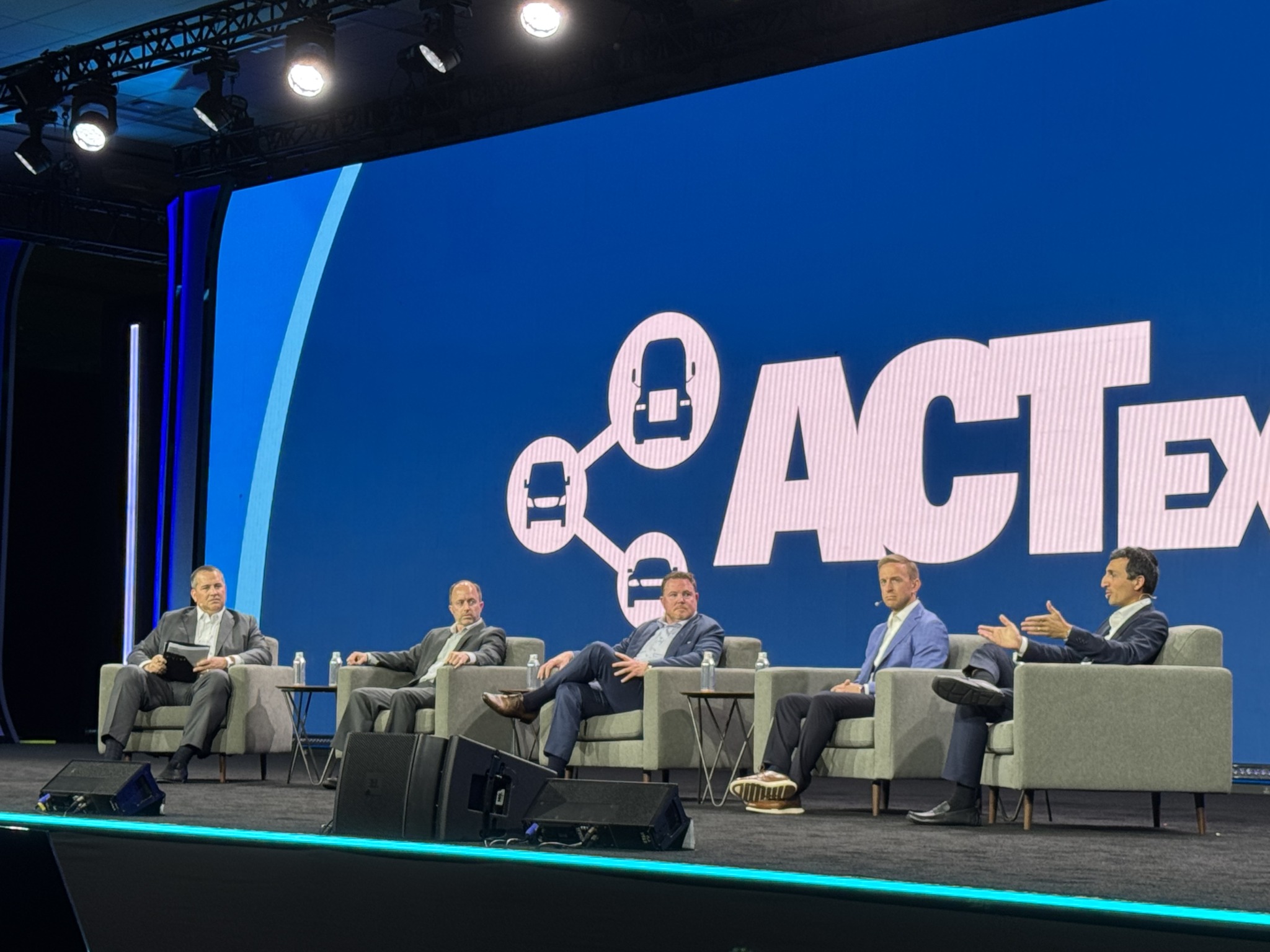
Speaking at a panel during the ACT Expo in Anaheim, Calif., executives from Amazon Freight, IMC Logistics, Unilever, and WattEV acknowledged growing pressure to decarbonize operations while highlighting economic constraints and infrastructure gaps that continue to slow down progress.
Ari Silkey, general manager at Amazon Freight, described how Amazon has spent the past eight years building out its transportation network through a technology-first approach. Starting in 2016, the company developed core systems including mobile apps, tracking tools, relay hubs, and carrier interfaces to support both consumer and commercial freight. With that foundation in place, Amazon scaled up to over-the-road and yard operations, procuring more than 60,000 trailers and 20,000 intermodal containers.

That infrastructure now supports Amazon Freight, which opens up the company’s internal transportation network to other shippers — managing loads that move inbound to Amazon, between warehouses, or entirely between external sites.
Amazon’s 2040 climate pledge, launched in 2019, laid out a long-term roadmap for decarbonization. “We’ve been investing in sustainable vehicles, whether it’s EV vehicles or CNG-powered,” Silkey said. To date, the company has deployed over 3,000 CNG trucks powered by RNG in the U.S. since 2019.
Customer, cost pressure
IMC Logistics, meanwhile, has set a goal to achieve a zero-emission fleet by 2028, but just over 10% of its trucks meet that threshold today. Jim Gillis, Pacific region president, acknowledged this goal is “pretty ambitious, especially in today’s economic climate.” He added that financial headwinds and shifting customer sentiment have created friction.
“Twenty-four months ago, I could go to any customer and they would tell me, ‘We’ll pay a little bit more for zero emissions technology.’ We just went through a brutal cycle of the last 24 months in the freight industry,” Gillis said. “The rate negotiations this year have all been about cost, right? So many customers say, ‘Hey, I love zero emissions technology, but I’m not willing to pay for it today.”
This disconnect has made it harder for fleets to plan, especially without long-term contract commitments that justify the high upfront costs of zero-emission equipment.
Internal alignment, progress over perfection
Unilever, which operates 14 warehouses across Canada and the U.S., has reduced emissions by 30% since 2020 and is targeting a 42% reduction in Scope 3 emissions by 2030. But getting there requires hard decisions and internal alignment. “Organizational alignment is essential for this type of work to be done,” Andrew Sylling, head of procurement, logistics North America at Unilever, said. “It goes from the top down with those big goals [and] all the way through the organization that has the alignment on sustainability. It is just [as] important as the overall cost structure.”
Sylling said Unilever’s approach to sustainability isn’t about waiting for the perfect conditions — it’s about making real, measurable progress where possible. He pointed to a renewable diesel project in southern California as an example of this mindset. The team had been locked in debates with European colleagues over carbon intensity metrics — on which values to use, and how to calculate emissions precisely.
“Don’t let perfection be the enemy of progress,” Sylling said. “We spent a lot of time debating with our European colleagues… Finally, we just decided we’re going to make progress. We have to deal with what we know now. Put it in place, test, learn, watch, observe, and change if you have to. So continuing to pursue areas where you can make incremental progress over time might not be the perfect solution, but it’s a percentage, a point or two closer to what your overall goals are.”
Utilization, infrastructure key to viability
Another challenge fleets are navigating as they build the infrastructure to support zero-emission freight is balancing ambition and practicality.
Salim Youssefzadeh, CEO of WattEV, said success in this space depends on more than just building charging sites — it requires aligning infrastructure with real-world utilization and profitability.
“What it comes down to is the utilization of the asset,” he said.
WattEV currently operates five charging sites, with 15 more in the pipeline. The company builds around tested, high-utilization routes, then offers fleets an integrated package.

“We’ve identified these routes, and now you can go to the other office and give them that whole bundled package of the infrastructure, the truck, and in some cases, the route,” Youssefzadeh said. “We’ve tested it, we know that it’s profitable.”
He also stressed that charging time remains one of the biggest constraints to electric truck adoption — something that megawatt charging could help resolve.
“Currently, it takes about two to three hours to charge… Once you go to that 1200 kilowatt range, that charge time drops rapidly, and it’s now around 30 minutes. We see that as a crucial step to relieve that wide-scale adoption,” he said.
Scalable pilot projects, long-term contracts
All panelists emphasized the role of pilot projects as a way to test technology, build trust, and share learnings.
“Everything starts with a concept and a pilot to prove out in the real world, how it looks, versus what’s on paper…And we always learn a ton in a pilot,” Amazon’s Silkey said. But pilots, he added, are only worthwhile if they’re designed with expansion in mind.
Silkey said with every pilot Amazon run, it sets clear performance criteria from the outset to ensure that, by the end of the test, it’s clear what has been learned, what gaps remain, and whether the solution is ready to scale.
Still, even successful pilots don’t necessarily lead to long-term results without contractual stability.
IMC Logitics’ Gillis said multi-year deals are foundational to making decarbonization work.
“In our model, a long-term contract, three to four years, is a great deal,” he said. He added that when costs are clearly understood, securing long-term commitments becomes a mutual benefit.

“If I can partner with the shipper and have a long-term relationship, that’s a win-win.”
Sylling of Unilever agreed, saying their natural gas efforts were only possible through dedicated fleet arrangements tied to longer contract terms of three years.
Youssefzadeh added that his team, too, always pushes for three-year contracts because they allow for better planning around asset deployment and charging infrastructure. Longer terms, he added, make it easier to forecast utilization and secure the resources needed to support a growing zero-emission network.
But even then, long-term commitment is not a silver bullet, said Gillis when talking about IMC’s past investments in now-bankrupt truck-maker Nikola. He used the example to reinforce that the availability of infrastructure, alternative fuels, and their price is yet another bleeding edge in green fuel adaptation.
He later spoke specifically of issues associated with hydrogen fuel, particularly in California, where infrastructure remains limited. While he acknowledged that more fueling sites are coming online, he said the current pace isn’t fast enough to meet fleet needs. A major concern, he added, is the volatility in pricing.
He explained that IMC initially benefited from subsidized hydrogen that achieved cost parity with diesel, but those prices have since tripled. “We need to get that price of hydrogen under 10 bucks a kilogram. If it doesn’t happen, hydrogen is not going to succeed.”