Hand-free and eyes-free technology is the preference for the majority of warehouse workers and management. David Priestman talks to Jonny Colledge, Sales Director EMEA Voice and Mobility for Infios, about how to maximise the benefits of voice tech.
Voice recognition is now mature technology, having been on the market for thirty years. It’s had some ups and downs but is back in vogue for sure. “It’s a go-to for some of the largest grocery retailers in the world, including Sainsbury’s and Morrisons,” Colledge tells me. “These companies tend to be early adopters, with tight margins, large warehouse staff numbers, hence lots of pickers undertaking manual, repetitive tasks across tens of DCs. Voice works best when there’s lots of people.”
How has voice tech evolved to overcome technical challenges such as failing to understand strong and foreign accents? “It’s gone through various iterations, starting off with ‘speaker dependent’ voice where you train the voice system to understand how you speak,“ Colledge explains. “The introduction of voice into the consumer market, such as for mobile phones, made the ‘independent voice’ become more prevalent. It’s really improved and will recognise your accent. Speaker dependent is still available and is suitable for seasonal workers because of the short training time available. We offer ‘Pick up and go’ to learn-as-you-go.”
Project Integration
Colledge has been with the company since 2011, when it was Voiteq, prior to the acquisition by Koerber Supply Chain Software (now known as Infios). The voice business has grown substantially during his time there, particularly in export markets and remains based in Blackpool. Infios now has 300 customers using voice in the UK alone, and similar amounts in both Germany and France. Uniquely, the original Voiteq business spawned from a local grocery retailer, Heralds Day & Nite Stores, that first developed and used the solution in 1999.
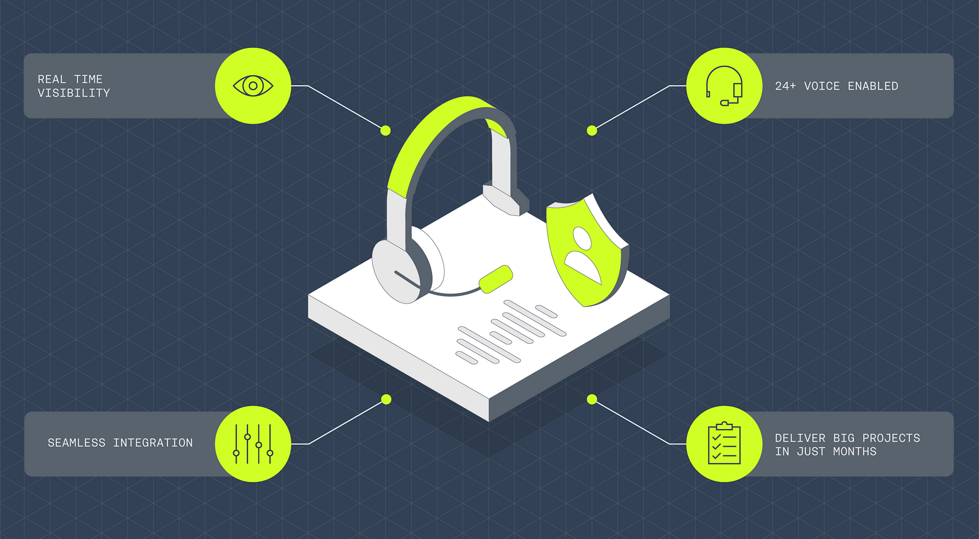
The benefits of a good voice-picking system partly derive from its seamless integration with a Warehouse Management System (which Infios also offers), real-time visibility of performance and order exceptions and the voice-enabled workflows. Voice is growing in line with other IT in the logistics industry. It is no longer offered bespoke, with a long integration period. “We have the expertise to deliver big projects in just a few weeks,” states Colledge (pictured, below). “Often customers are interested in voice and then decide to upgrade their WMS, rather than buying software first and adding voice on afterwards. It’s very evident, when you go to see a potential customer, what it is they need.”

Infios is ‘hardware agnostic’ vis-à-vis voice and does not manufacture hardware. “We can put voice on any hardware technology brand or scanners,” he adds. “You can work with a variety of hardware, it depends on the warehouse environment. We’ve done a lot of work with several AMR suppliers to integrate voice with robotics, so that a robot can substitute for a person on a picking shift, using the same voice commands. The two technologies complement each other.”
Talk Picking To Me
Voice installation still often requires an educated sell. Customers normally need an explanation of why they need voice. How do suppliers get the industry to the point of knowing it needs voice? What would accelerate demand? The company takes a platform approach. “The education process is necessary. We’re pushing voice as the gateway and lead with it in sales, as we have a competitive advantage. References are key, to show customers that have had a negative experience of voice in the past that it can be done better. It can achieve a quick boost to productivity. There’s good voice and bad voice and it really depends on the process efficiency. Start there, not with the technology. Define what it is you’re going to do.”
Automation is increasingly popular in warehouses. But many operations, including growing businesses, cannot afford full automation, a goods-to-person solution or the ‘dark warehouse’ scenario. Trends come and go. Voice aims to be a low-investment, quick ROI, as well as a complementary solution with automation. In terms of the outcomes and gains, Infios start by analysing the process. Is it screen-based, is the WMS good? “If yes, we make it voice-enabled, go down the ‘connector’ route and achieve 8-12% productivity improvements,” Colledge explains. Alternatively, if the WMS is not ‘tier 1’? “We also offer WES (warehouse execution software) with voice. That takes a bit longer, but productivity benefits tend to be around 25% because there’s more process re-engineering to do.”
Generative predictive AI models have been used for a decade in Infios’ voice system. “It provides the capability to analyse orders and determine whether the outbound cut-off time will be met for a given carrier, for example. If not, the system will calculate that more pickers are needed in that area, how many and where you can take them from. The next step for us is the platform approach; to go further than just present information on a dashboard and to take actions, such as rearranging fast-moving goods. Where we’re going is to the system defining functions. You wouldn’t want a warehouse manager to have to digest all the information. Set a rule that says, if that happens the system will take care of it. That’s where AI and voice will converge. The operator is informed where to go next, with decisions made by the system in the background.”
Investment spending is tight. Infios look to implement voice picking, achieve proof-of-concept, then integrate it across multiple processes. Incremental gains are made. Speeding-up some processes may cause bottlenecks elsewhere. Ultimately a new, superior, WMS may be required. Reviewing the entire process first is best. As the voice system is modular, customers have access to the platform going forward and have options, including TMS.