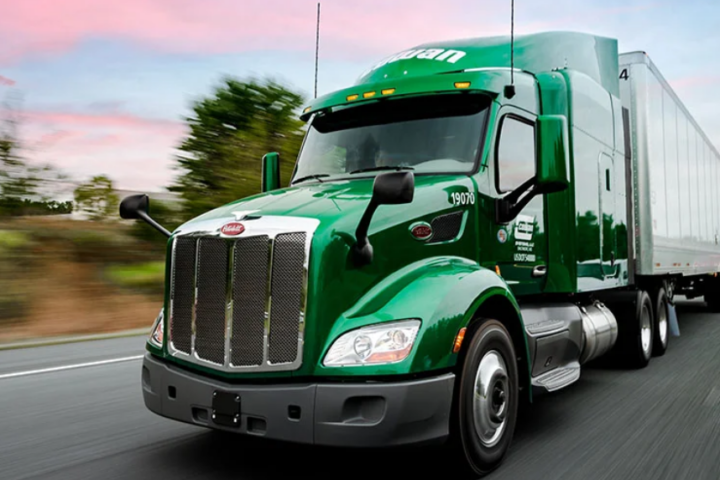

Class 8 trucks account for nearly 80% of all energy consumed by medium- and heavy-duty vehicles in B.C.’s Lower Mainland, despite representing about 60% of the region’s fleet, according to a new study commissioned by the B.C. Trucking Association (BCTA).
Developed in partnership with Deloitte, with input from the provincial government, BC Hydro and FortisBC, the study examines the current state of the MHDV (Medium Heavy Duty Vehicle) sector and models how different fuel and powertrain technologies could be adopted through 2050 in the Lower Mainland.

The estimated total MHDV energy demand in the region is 61 petajoules (PJ), with Class 8 trucks alone consuming roughly 49 PJ. Translating into roughly 80% of the total, the numbers point toward the ‘critical importance’ of targeting the MHDV segment for decarbonization, the study reads.
Diesel continues to dominate the sector, representing about 95% of total energy use across all vehicle classes. Meanwhile, alternative fuels struggle to gain popularity, with fewer than 2% of vehicles currently operating on compressed natural gas (CNG), battery-electric (BEV), or hybrid-electric (HEV) technologies, collectively contributing less than 1 PJ to total energy demand.
Fleets’ perspectives
The main freight corridors in the area are Highways 1, 99 and 17, connecting ports, logistics hubs and cross-border trade routes through Surrey, Delta, Richmond and Vancouver. While Surrey serves as the region’s central freight hub, combining high concentrations of domiciled fleets with substantial corridor traffic volumes, secondary routes like Highway 11 provide targeted connectivity for agricultural and regional trade but carry comparatively lower Classes 5–8 traffic.
Fleets operating in the Lower Mainland — interviewed as part of the study — said that when it comes to buying new trucks, purchasing decisions are ultimately driven by duty-cycle fit, infrastructure access, OEM support and total cost of ownership.
When asked about specific market-ready greener technology, BEVs are commonly recognized as the most commercially ready zero-emission technology. But there is a need for megawatt-level charging infrastructure. This, carriers say, will enable longhaul operations and mitigate the range constraints associated with weather conditions.
Fuel-cell-electric trucks (FCEVs) were viewed as a longer-term option, with pilot project interest contingent on government support, reliable hydrogen supply chains, and confidence in vehicle availability from OEMs. And CNG adoption is halted due to earlier negative experiences with vehicle performance and maintenance.
Adoption scenarios, infrastructure needs
To assess possible decarbonization ways for the sector, the study modelled three technology adoption scenarios — base, reserved, and optimistic — revealing distinct pathways for different fuel technologies.
And while in all scenarios, diesel-powered trucks are expected to continue dominating longhaul operations exceeding 500 km per day in the near term, the study does point to renewable diesel and biodiesel as important transition fuels.
For now, electric trucks show strong potential for short-haul applications under 500 km (310 miles) per day with lighter loads, up to 25,000 lb. The report estimates that in 25 years, the market share in suitable applications could reach nearly 50%, with energy demand approaching 3 PJ (approximately 800 GWh).

But adoption at that scale would depend on significant grid capacity upgrades at critical fleet yards and extensive charging infrastructure deployment along key corridors. As demand is expected to concentrate along the Highway 1 and Highway 17 corridors, private depot charging is highly recommended in these areas.
FCEVs are projected to play a role primarily in Class 8 longhaul applications, with energy demand potentially reaching about 2 PJ by 2050. But success will depend on competitive hydrogen pricing, reliable delivery infrastructure, and strong manufacturer support. Additional hydrogen infrastructure investment is projected for two major demand areas: Highway 1 near Abbotsford Airport and the Chilliwack corridor along Highway 1.
As for CNG perspectives, a compelling case exists for its longhaul application in Classes 7–8, with demand projected to reach 9 PJ by 2050 under favorable conditions, such as improved vehicle reliability and rapid infrastructure development. The highest CNG demand hotspots are projected near Abbotsford Airport and Campbell Heights, requiring up to three fast-fill public refueling stations.