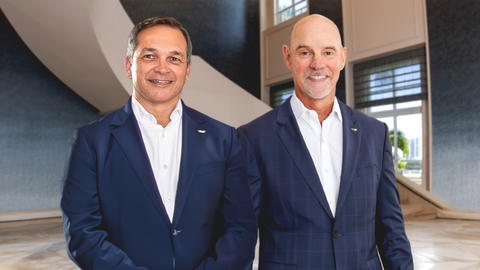
As another year draws to the end, it seems that change is happening faster than ever: technological advance continues to race forward, global dynamics are shifting on a near daily basis, and consumer expectations are evolving faster than at any time in retail history, writes Martin Lockwood (pictured, below), Senior Director of Manhattan Associates.
If there’s one prediction that comes true every year, it’s this: what worked last year won’t cut it in the next edition. And, while predictions are notoriously difficult to make with any certainty, our 2026 forecasts aren’t just guesses, they’re born of powerful, data-driven insights, professional experiences gained over decades and what we’ve seen (and heard) from customers over the last twelve months.
Every new year offers the chance to shape the future, not just watch as a bystander as it happens. At Manhattan, our mission has never been simpler: cut through the noise, focus on what truly matters to our customers, and make sure we’re not just keeping up with change, we’re leading it.

Below is a selection of predictions for 2026 from our team of experts from around the globe. From the ongoing creep of AI into all areas of business, the evolution of commerce as we know it, and what trends like ‘hyper-personalisation’ mean for already stressed (B2B and B2C) supply chains, hopefully, these insights will provide food for thought and provoke some interesting conversations in the New Year!
- While 2026 will see AI tools deployed more extensively to reduce the cost of labour-intensive tasks and accelerate project deployments significantly, these tools will also evolve to offer incident management capabilities, leading to machine-driven self-healing and ultimately, more resilient supply chains.
- Professional services organisations will accelerate the adoption of AI-driven automation to streamline delivery, enabling faster onboarding, smarter resource allocation, and support models that improve operational delivery. As clients demand more transparency and value, Professional services teams will shift toward outcome-based engagements, leveraging real-time data and collaborative platforms to co-create solutions and demonstrate measurable impact.
- While we can expect to see more organisations leveraging new AI capabilities next year, the growth will be a slow climb as supposed to the frenetic pace of the last 24 months. 2026 will be the year organizations quickly realise that they need data cleanup and digital modernisation if they want to leverage new AI capabilities effectively, and deliver the speed, accuracy and true value, everyone is looking for.
- In the B2B space, intelligent decision making at the moment of the truth, (i.e. the moment that customer wants to place the order), is becoming more and more the norm as organisations look to maximise customer service and profitable operations. Intelligent sourcing, order allocation versus supply, and continuous re-allocation will be a recurring theme, putting ERPs in the spotlight when it comes to meeting customer expectations in 2026.
- The consumer is now ubiquitous: they want to transact anywhere, have orders fulfilled however they chose and return items how and when they like. As a result, supply chain will have no choice but to commit in real-time to consumer orders, regardless of what channel the order comes from. Expect an acceleration of unified commerce uptake as retailers battle with the increasing demands of hyper-personalisation.
- By the end of 2026, legacy registers will be replaced by mobile-first POS platforms that function as omnichannel hubs rather than transaction terminals. These platforms will connect to real-time inventory and fulfilment engines, giving associates dynamic options like ship-from-store, pick-up-later, or same-day delivery at the point of decision. They will (crucially) also deliver context-rich associate experiences including customer history, loyalty status, recent browsing and open carts, so staff can serve customers faster, with more accuracy and a greater degree of personalisation.
- Retailers such as Walmart have already announced huge investments in
conversational commerce and we can expect it to fundamentally change how we shop online, moving from traditional search to AI interaction shopping. - Social commerce will continue to accelerate at a rate of knots. Tik Tok Shop has just had a record year with 6,000 live shopping sessions being held every day on the platform, on average. M&S in the UK is one of the latest retailers to jump into this new sales channel so expect many more to follow suit in 2026.