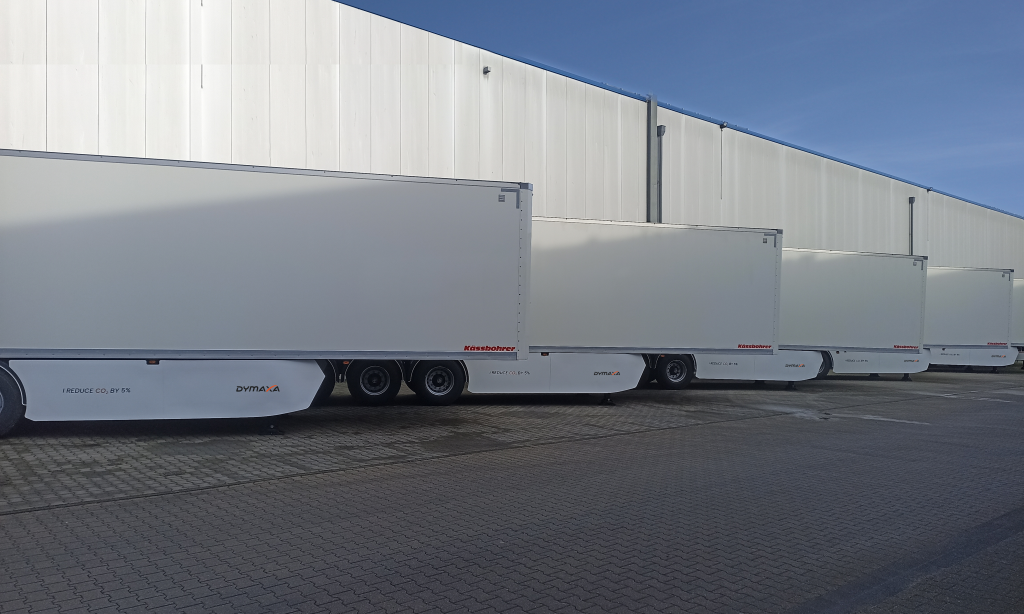
Has the moment finally arrived for side skirts to be successfully deployed across Europe’s road transport truck network? Just maybe. Paul Hamblin spoke to Almaz Ayupov, Founder and CEO of Dymaxa.
Side skirts – aerodynamic devices attached to the side of trailers and semi-trailers to reduce air drag and thus improve fuel efficiency and carbon emissions – are familiar sights on the interstates and freeways of North America.
But Europe? It’s never happened, largely because fleet owners and managers were uncomfortable about two important factors – the (then) high cost of skirts, and their doubtful durability.
In a world seeking ever more efficient and ingenious ways to cut emissions in order to meet regulatory standards, sustainability targets and high customer expectations, this matters. A European Environment Agency quoted by Dymaxa claims 110 million tons of CO2 are ‘lost’ to poor aerodynamics.
Given that context, if a company could set out a product in European conditions that not only provably demonstrates fuel and carbon savings, but which also offers guaranteed durability, the rewards for its customers might potentially be very attractive.
Step forward Almaz Ayupov, a Columbia University graduate and former Bain consultant, who has now founded Dymaxa (formerly known as Aerodymax). The aim is to establish trailer skirts to be as common in Europe and the rest of the world as they are across the Atlantic.
They have three key weapons at their disposal to overcome the sceptics: lower cost price, proven test numbers and durability.
Cost
“Earlier versions of the trailer skirt in Europe were priced at about €5,000 or more,” Almaz Ayupov explains. “That made it hard for operators to achieve positive ROI, especially when the skirts inconveniently broke under real operating conditions. Our own product starts at under €2,000 for both retail and bulk purchases and we estimate payback in less than 12 months for trailers driving over 10k km per month.”
Durability
It’s not hard to see why resilience is an issue for trailer skirts. They must be able to withstand the impact of daily operations, such as loading, unloading, and intermodal transfers, as well as repeated contact from kerbs, speed restriction bumps or narrow entrances and exits. Since previous iterations of side skirts were plastic, breakage was almost inevitable.

“In North America, side skirts are made of strong, flexible composite materials,” says Ayupov. “Ours are improved by using fibreglass-reinforced composite. It has been tested by users and it works, repeatedly.”
The proof is out there on Europe’s roads, he claims. “Over 300 trailers are currently equipped with Dymaxa side skirts in Europe and no warranty case has ever been reported,” he says. He is confident enough to back this assertion with four-year full warranty for every new Dymaxa sold, and a 100% refund if you are not satisfied. Moreover, the company has added an unprecedented extended warranty of two years, by which the company takes care of any damage including by driver/customer fault.
ABInBev and TV Trailers are both returning paying customers from an increasing roster, with more under NDA, including the biggest beverages manufacturer.
The savings
Key to the business case for skirts is their capacity to reduce air drag and save both fuel and emissions. In 2023, AB InBev and Jost Group conducted a large-scale pilot to evaluate Dymaxa’s aerodynamic side skirts on 26 trailers running between Belgium and France, resulting in a reported average saving of 4.9%. “Following the successful pilot AB InBev has now been using the skirts for over 2.5 years without any issues and launched a collective buying programme for their carriers, encouraging them to reduce their emissions and thus lowering their scope 3 emissions,” says Almaz.
He is at pains to point out that the pilot was conducted under strictly controlled conditions to ensure accurate measurements of real-world conditions. “Factors such as route selection, cargo load, driver behaviour, and equipment configuration were carefully controlled throughout the pilot, with the same drivers operating along identical routes to ensure consistent conditions. In total, over 100,000 kilometres were driven at an average speed of 68 kilometres per hour on a fixed route between Belgium and France.”
An equal number of control vehicles were used. “The pilot thus consisted of 26 trucks with Dymaxa skirts and 26 trucks without Dymaxa skirts,” he explains. “The trucks of both the control group and the group using Dymaxa skirts were exactly the same models.”
Many more of Europe’s leading truck fleets, trailer rental companies and biggest OEMs have extensively tested the product and become Dymaxa side side skirt operators in the last 18 months, including H. Essers, Heisterkamp, Grupo Sese, Kreiss, TC Trailers, Schwarzmüller Group, and Delanchy.
Ivans Svecovs, CTO fo Kreiss, said: “We tested the Dymaxa solution and were impressed with a 4–5% fuel consumption reduction. We are now testers and partners in developing a side skirt with an integrated pallet box. We look forward to using it on our 1,500 refrigerated trailers to drive efficiency for our customers.”
Dymaxa is refining and improving its offering all the time. The latest iteration of the product is a complete trailer underbody system which integrates four common underbody components into one integrated system, all with improved access and attachment capabilities.