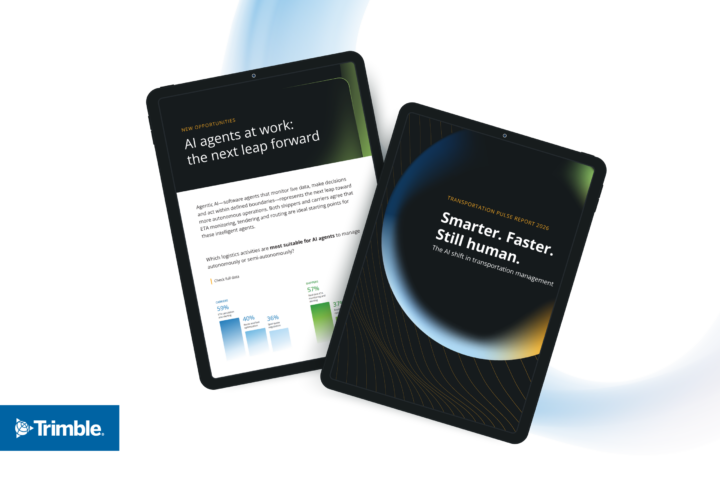
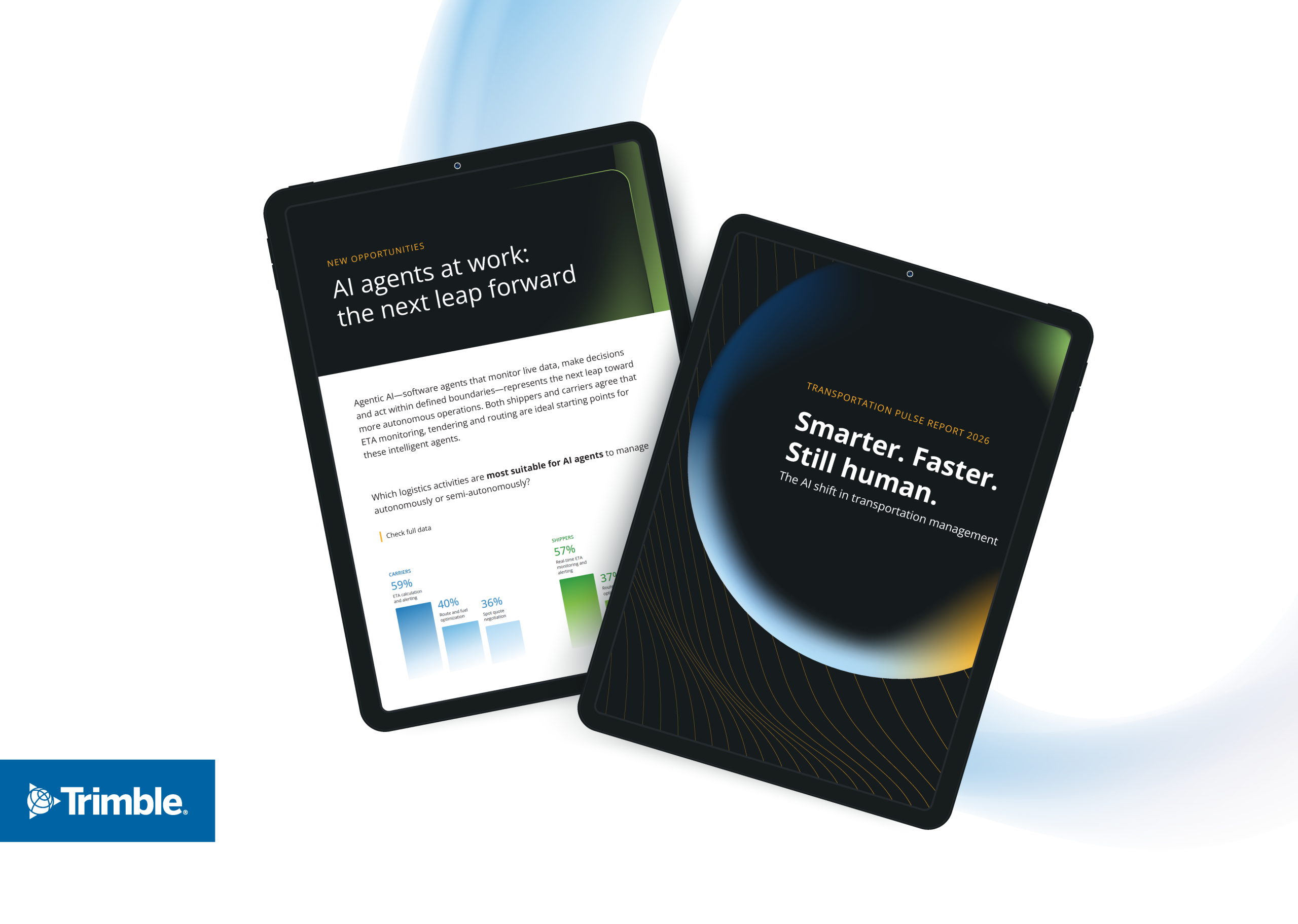
Transporeon, a Trimble company, has released its annual Transportation Pulse Report, surveying over 230 supply chain and logistics executives across Europe and North America to assess AI’s impact on transportation management and identify how the technology is transforming operations.
The report confirms transportation has reached an AI inflection point: the ways companies respond to the rapid development of AI within the sector may define their competitive edge for years to come.
Adoption accelerates, data quality lags
AI adoption in transportation management is gaining momentum, though most companies remain in early stages:
- Shippers are experimenting across multiple areas: 44% of survey respondents are already using AI in transportation planning and optimisation, with additional applications in freight procurement and real-time visibility.
- Carriers focus on pricing and tracking: 42% are deploying AI for pricing and lane optimisation, with 39% using it for real-time tracking.
The limiting factor? Data quality. Inconsistent data remains the biggest obstacle to AI success, with shippers and carriers both citing it as their primary barrier to adoption.
AI’s top application: planning, pricing, execution
When asked where AI will have the greatest effect over the next 3-5 years, shippers and carriers are using AI to fine-tune transportation planning, pricing and execution. But their priorities differ:
- Shippers prioritise transportation planning and optimisation: 86% expect AI to significantly impact this area.
- Carriers focus on pricing and lane optimisation: 59% identify this as AI’s main value driver.
Respondents note a shift from early-stage experimentation with AI to now focusing on leveraging the technology for measurable efficiency gains.
The rise of AI agents
Survey respondents pointed to distinct opportunities for Agentic AI, autonomous software agents that monitor data, make decisions and execute tasks within defined boundaries:
- For shippers, opportunities to improve workflows through the use of Agentic AI include real-time ETA monitoring (52%), with route/network optimisation and carrier selection and tendering also emerging as priorities.
- For carriers, the priorities are ETA calculation and alerting (59%), with route and fuel optimisation and spot quote negotiation also ranking high on the list.

Despite the potential of automation, two-thirds of shippers and more than half of carriers still see AI’s primary role as augmenting human decision-making rather than replacing it, with most preferring human-in-the-loop approaches.
Still, this marks a turning point: logistics teams are in the early stages of trusting systems to act on their behalf and not just provide insights.
A connected ecosystem boosts AI value
The report emphasises that AI’s full potential emerges within connected ecosystems that enable seamless data exchange, not locked in company silos:
- 43% of shippers cite enhanced predictive capabilities (ETA accuracy, disruption risk management) as the top benefit of combining AI with network-based TMS, while 55% of carriers see the biggest benefit in smarter load matching.
Jonah McIntire, chief product and technology officer, transportation and logistics at Trimble, commented:
The true value of AI lies not just in the technological innovation itself, but how quickly and effectively it can be operationalised and integrated throughout your supply chains. The companies that embrace AI across their systems, partners, and people, will deliver faster, smarter and more efficient operations and better business outcomes.